Off Grid Solar System Design: 48V LiFePO4 Guide
Off Grid Solar System Design: 48V LiFePO4 Guide
Off Grid Solar System Design: A 48V LiFePO4 Configuration Guide for 24-Hour Power
In many off-grid and weak-grid markets, the grid is an interruption, not a constant. Daily outages of 8 to 12 hours are routine, and the default backup — a diesel or petrol generator — burns fuel at local pump rates of roughly $0.30 to $0.70 per hour before you count noise, fumes and engine maintenance. For homeowners, small business owners and EPC contractors, the better answer is solar energy stored in batteries and used through the night.
That is what a properly executed off grid solar system design delivers: 24-hour power from your own installation. The difference between a system that runs reliably for a decade and one that dies at 2 a.m. is configuration — battery capacity, inverter matching, BMS communication and cable sizing all have to line up. This guide covers why 48V is the right architecture, how to select each component, a step-by-step sizing method, three ready-to-use configurations with 2026 pricing, BMS integration, commissioning, and the mistakes that sink most projects. Every number below is chosen for weak-grid and tropical conditions: high ambient temperature, seasonal dust and generator-dependent budgets.
Why 48V Architecture Is the Right Choice for Off-Grid Systems
Below roughly 3kW of continuous load, a 12V or 24V system is workable and cheaper to build. Above 3kW — where most off-grid homes with freezers, borehole pumps and air conditioners actually sit — system voltage becomes the most important design decision, because current is what drives cable size. Power is voltage multiplied by current, so at any fixed wattage, lower voltage means higher current.
A 5kW load draws about 417A at 12V and 208A at 24V. At 48V, the same load draws roughly 104A. That is not academic: a 48V system carries 5kW on a single 25mm² (2 AWG) cable pair, while a 12V system needs multiple parallel 4/0 runs. Lower current means thinner cables, smaller breakers, less voltage drop, less heat and fewer points of failure.
The 48v vs 24v solar system question therefore resolves quickly above 3kW: 48V wins on cable cost, efficiency and safety, and it is the native input of nearly every hybrid inverter in the 5kVA-20kVA range commonly shipped to weak-grid markets. A 48v solar system also scales — from 5kWh to 60kWh by adding packs in parallel — which is why installers standardise on it.
| Parameter | 12V System | 24V System | 48V System |
|---|---|---|---|
| Max practical continuous power | ~2kW | ~3-5kW | 5kW-20kW+ |
| Typical cable gauge for 5kW | 4/0 AWG, parallel runs (impractical) | 2/0 AWG (~208A) | 2 AWG / 25mm² (~104A) |
| Voltage drop at 5m (estimate) | ~5%+ | ~3% | ~1.5% |
| Inverter availability | Rare above 3kVA | Up to ~5kVA | 5kVA-20kVA standard |
| Battery parallel limit | 2-4 typical | 2-4 typical | 4-8 typical (BMS-dependent) |
| Best for | Small loads, single appliances | Small homes under 3kW | Homes, SMEs and businesses above 3kW |
The voltage drop figures are estimates for a typical 5m battery run with reasonable gauge; your exact numbers come from a voltage drop calculation using your cable length and size.
Core Components of a 48V LiFePO4 Off-Grid Solar System
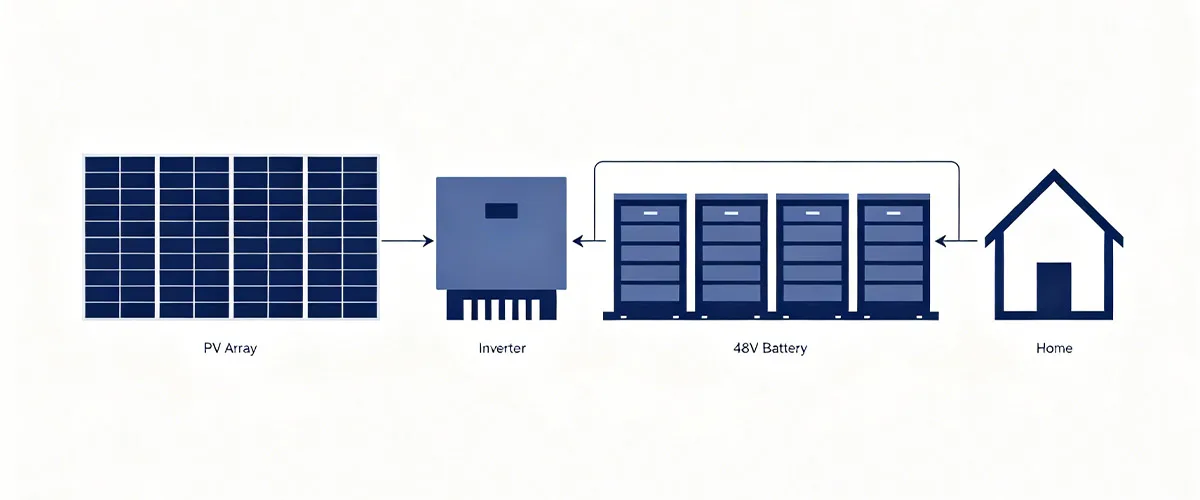
A 48v system is five groups of components. Getting each one right matters more than brand choice.
1. 48V LiFePO4 Battery Bank
A 48V LiFePO4 battery system is a 51.2V nominal pack — 16 prismatic cells of 3.2V in series, marketed as “48V”. Common capacities are 100Ah (5.12kWh), 200Ah (10.24kWh) and 300Ah (15.36kWh) per unit. The 48v 100ah wall-mounted lifepo4 battery system is the most common entry point for off-grid homes because one 5.12kWh unit pairs cleanly with a 5kVA inverter and can be expanded later. Verify before purchase: BMS quality; cycle life above 6,000 cycles at 80 percent DoD; continuous discharge current (100A+ for a 100Ah pack); peak discharge for 5-10 seconds; and CAN or RS485 communication ports. Expansion is parallel only: two 100Ah packs give 10.24kWh, four give 20.48kWh.
2. Hybrid Inverter (48V)
Hybrid inverters for this architecture come in 5kVA, 8kVA, 10kVA, 12kVA and 20kVA ratings. Three requirements are non-negotiable. First, a LiFePO4 charging profile — absorption 57.6V and float 51.2V, or user-adjustable settings, since no two battery brands charge identically. Second, a built-in MPPT charge controller in the 60A-120A range, so a 48v solar power system charges directly from PV without a separate controller. Third, parallel capability, so two 10kVA units can serve a growing load. For 48v inverter setup, set battery type, absorption and float voltages, low DC alarm (46V) and cut-off (44V) during commissioning — not after the first week of operation.
3. Solar PV Array
Monocrystalline panels of 450W-550W are the current standard; higher wattage means fewer panels and fewer connections. Array voltage must sit inside the inverter’s MPPT window, typically 60-450V DC. For equatorial and tropical regions, tilt panels at 10-15° facing the equator, and budget for seasonal dust: dry-season dust events can cut output by 20-30 percent, so schedule monthly cleaning and add 10-15 percent PV margin.
4. Battery Management System (BMS)
A lifepo4 battery management system is what makes a stack of cells safe to live with. The bms battery management system lifepo4 cells need handles the same jobs regardless of brand: over-voltage and under-voltage protection per cell, over-current and short-circuit protection, temperature monitoring, cell balancing and inverter communication. A pack without a functioning BMS is not a battery; it is a hazard.
5. Balance of System (BOS)
The BOS is where installations live or die: a DC disconnect between PV and inverter, a PV combiner box for parallel strings, surge protection devices on both DC and AC sides, properly sized cables (4AWG to 2/0 depending on current), battery busbars, and a common earth rod grounding the inverter chassis, PV frame and battery rack. Keep battery-to-inverter cable runs under 3m and size the gauge from a voltage drop calculation — not from what the electrician had in the van.
Step-by-Step: Designing Your Off-Grid Solar Power System
Designing off grid solar power system is arithmetic, not guesswork. The seven steps below are the same sequence used in professional 48v solar system design, and together they form a solar system configuration you can defend to a client or a bank. This is where 48v solar system sizing happens in practice: battery first, panels second.
- Audit your load. List every appliance, its wattage and daily hours of use, then sum the daily Wh. If labels show different units, use the convert watts to kWh tool to standardise. Add 30 percent for losses and future expansion.
- Determine battery capacity. Divide daily Wh by system voltage (51.2V) to get Ah, divide by 0.8 for usable capacity at 80 percent DoD, and round up to a standard pack size. The battery capacity calculator works backwards too: enter target hours and it returns the kWh you need.
- Size the inverter. Continuous load × 1.25 for the minimum rating, plus 2-3x surge allowance for motors and compressors. A 5kVA unit is the sensible minimum for an off-grid home; 10kVA for a small business.
- Size the PV array. Daily Wh ÷ (peak sun hours × 0.75 system efficiency). Most equatorial and tropical regions get 4.5-5.5 peak sun hours — use 4.5 for cloudy belts, 5.5 for sunny arid belts.
- Configure battery parallel/series. 48V packs connect in parallel only — never series, which pushes voltage past the inverter input range. Most BMS units allow 4-8 packs in parallel; check the datasheet before buying the fourth pack.
- Design cable runs. Keep battery-to-inverter cables under 3m, select gauge from a voltage drop calculation, and torque M8 terminals to 8-12 Nm.
- Plan for generator backup. Most hybrid inverters accept a generator input and auto-start it when battery SOC drops below a set threshold — essential for extended cloudy periods and high-load days.
Three Ready-to-Use 48V System Configurations
The three configurations below are starting points, not quotes. They follow the modular energy storage system designs philosophy: start within budget and expand in 5.12kWh steps as load grows. Every battery energy storage system design here uses the same logic — storage sized to carry the night, PV sized to refill it by midday, inverter sized to survive startup surges.
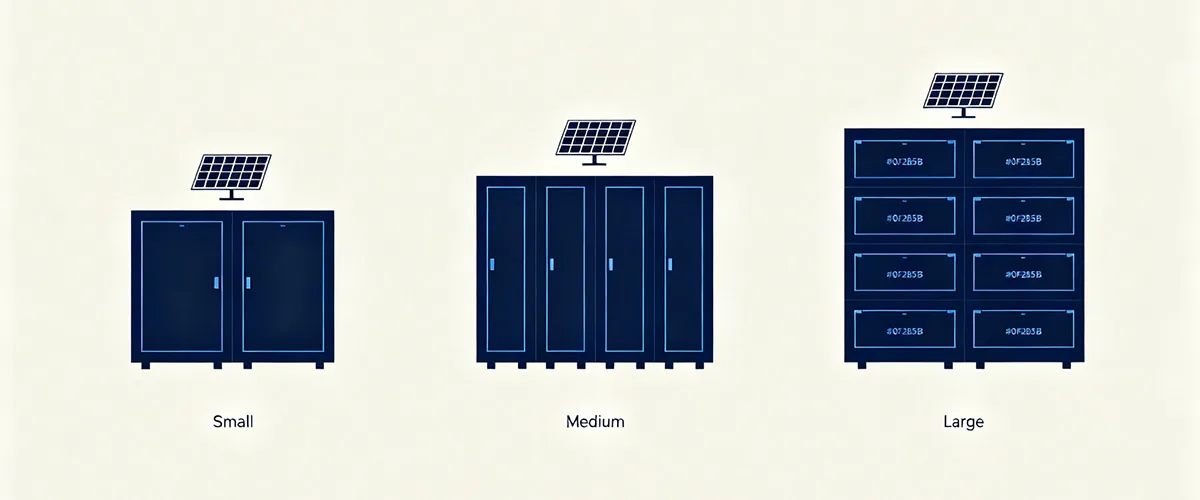
For 2026 global reference pricing, use these points: a home battery system price for a 5.12kWh 48V pack runs $650-900; hybrid inverters cost $450-2,000 depending on size; and installed 500W panels run $140-200 each. The total off-grid solar system cost therefore moves almost entirely with battery count and PV wattage. All figures are estimates and vary by region and install complexity.
| Component | Small Home (3-5kW) | Medium Home/SME (8-10kW) | Large Home/Business (15-20kW) |
|---|---|---|---|
| Daily energy target | 8-10kWh/day | 20-30kWh/day | 40-60kWh/day |
| LiFePO4 battery (48V) | 2-3 × 100Ah packs (10.24-15.36kWh) | 4-6 × 100Ah packs (20.48-30.72kWh) | 4-6 × 200Ah packs (40.96-61.44kWh) |
| Hybrid inverter | 5kVA | 10kVA | 2 × 10kVA parallel or 20kVA |
| PV array | 2.5-3.5kWp (5-7 × 500W) | 6-8kWp (12-16 × 500W) | 12-16kWp (24-32 × 500W) |
| Est. runtime (full load, no sun) | ~2.5-4h | ~2.5-3h | ~2.5-3.5h |
| Est. runtime (partial load, with solar) | 24h at 8-10kWh/day use | 24h at 20-30kWh/day use | 24h at 40-60kWh/day use |
| Typical use case | 2-3 bedroom home, small shop | Larger home, pharmacy, restaurant | Supermarket, workshop, compound |
| Est. total cost range (USD) | $5,000-9,000 | $10,000-16,000 | $22,000-38,000 |
Full-load runtime figures are estimates at 80 percent DoD and 95 percent inverter efficiency; actual runtime depends on your real draw and settings.
BMS Integration: Making Your 48V LiFePO4 System Talk to the Inverter
The most common configuration error is installing a 48v battery system configuration without connecting the BMS to the inverter. Modern hybrid inverters and LiFePO4 packs communicate over CAN bus, with RS485 as the slower fallback, and that link changes how the whole system behaves.
The BMS tells the inverter the state of charge (SOC), maximum charge and discharge current, fault states and cell temperature. With that data, the inverter stops charging at the right voltage, throttles charging in heat, and never draws more current than the pack can deliver.
Without BMS communication, the inverter defaults to a generic lead-acid charging profile. The result is overcharge or undercharge, cell imbalance, and a battery that degrades in two to three years instead of ten. If a pack’s BMS cannot talk to your inverter, choose a different pack.
Brand matters less than protocol compatibility. The major inverter brands widely available across off-grid markets — Deye, Growatt, Luxpower and Sofar — all ship LiFePO4 presets and CAN/RS485 ports. Confirm the battery’s protocol appears on the inverter’s supported list before purchase.
| Parameter | Value (16S, 51.2V nominal) |
|---|---|
| Nominal voltage | 51.2V (16 × 3.2V cells) |
| Absorption (bulk) voltage | 57.6V |
| Float voltage | 51.2V (disable where supported) |
| Low DC alarm | 46V |
| Low DC cut-off | 44V |
| Cell operating range | 2.5V-3.65V (3.0V-3.45V for longest life) |
| Max continuous charge current | 0.5C (50A per 100Ah pack) |
| Max continuous discharge current | 1C or BMS limit (100A per 100Ah pack) |
Installation & Commissioning Checklist
Whether this is a first-time 48v lifepo4 setup or a professional 48v inverter setup, how to build 48v lifepo4 system that lasts is commissioning discipline. Run every step on each installation.
- ✓ Battery placement: well-ventilated, away from direct sunlight, ambient 10-30°C ideal (tropical ambient can hit 35-40°C — add ventilation or AC for the battery room)
- ✓ Cable torque: follow manufacturer specs (typically 8-12 Nm for M8 terminals)
- ✓ First charge: charge to 100 percent with PV or generator before the first heavy discharge
- ✓ BMS-inverter communication: verify the SOC reading matches on both devices
- ✓ Low voltage cut-off: set inverter low DC alarm at 46V, cut-off at 44V for 51.2V nominal
- ✓ Grounding: inverter chassis, PV array frame and battery rack all grounded to a common earth rod
- ✓ Load test: run full load for 1 hour, monitor voltage drop and battery temperature
- ✓ Record baseline: note full-charge voltage, resting voltage and estimated runtime for future comparison
6 Common Mistakes in 48V Off-Grid System Design (and How to Avoid Them)
Six errors account for most off-grid failures, and all of them trace back to skipping the arithmetic above.
- Undersizing the battery. Using nominal kWh instead of usable kWh (multiply by 0.8 for DoD): a 10kWh battery gives 8kWh usable. A proper off grid solar power system design calculator asks for DoD before it returns a battery size — if yours does not, find another one.
- Ignoring surge loads. A 1.5HP air conditioner draws about 1.2kW continuous but 3-4kW at startup. The inverter must handle the surge, not just the steady draw.
- Using a lead-acid charging profile on LiFePO4. It overcharges or undercharges the cells. Always select the LiFePO4 mode, or set absorption and float voltages manually.
- Too few PV panels. Sizing for average sun hours without accounting for dry-season dust events leaves you 20-30 percent short in the dustiest months.
- Long, thin battery cables. More than 3m of undersized cable causes significant voltage drop and heat. Run a voltage drop calculation before pulling cable.
- No generator backup plan. Even the best PV+battery system faces 2-3 cloudy days per year. Plan for generator input or grid charging.
All of the tools for avoiding these mistakes — capacity, runtime and conversion calculators — are collected in the free battery calculators hub, so you can run the full sizing procedure without a spreadsheet.
Maintenance: Keeping Your 48V System Running for 10+ Years
Monthly: clean PV panels (especially in dust season), check cable connections for tightness, log battery SOC and voltage. Quarterly: inspect battery terminals for corrosion, verify BMS firmware version, test generator auto-start if fitted. Annually: run a full load test, compare battery capacity against nameplate, inspect inverter cooling fans and update firmware.
With 6,000+ cycles at 80 percent DoD, a daily-cycled LiFePO4 pack lasts roughly 15 years — but only if the rest of the system is maintained. Good energy storage system design plans access to every component, and a 48v energy storage system design that accounts for tropical heat and dust keeps cells in the 10-30°C band where cycle life is longest.
Frequently Asked Questions
What is the best voltage for an off-grid solar system?
For systems above 3kW continuous, 48V is the standard. It reduces current by 4x versus 12V, allowing thinner cables and higher efficiency. Below 3kW, 24V is acceptable; below 1kW, 12V works.
How many 48V 100Ah batteries do I need for 24-hour power?
It depends on load. A typical off-grid home using 10kWh/day needs about 2.5 packs of 5.12kWh (12.8kWh nominal, 10.2kWh usable at 80 percent DoD). Round up to 3 packs (15.36kWh) to cover cloudy days.
Can I mix different brands of 48V LiFePO4 batteries in parallel?
Not recommended. Different BMS firmware, charge curves and internal resistance cause imbalance and premature aging. Use identical packs from the same manufacturer, ideally from the same production batch.
How much does a complete 48V off-grid solar system cost?
Small home (3-5kW): $5,000-9,000. Medium home/SME (8-10kW): $10,000-16,000. Large home/business (15-20kW): $22,000-38,000. Prices vary with component quality, labor rates and installation complexity in your region.
Do I still need a generator with a 48V solar system?
For 24/7 reliability, yes — as backup for extended cloudy periods and unexpected high loads. Most hybrid inverters have a generator input that auto-starts when battery SOC drops below a set threshold.
Summary: Design for the Night, Not the Datasheet
A well-designed 48V LiFePO4 off-grid system can deliver true 24-hour power, but the design — load audit, battery sizing, inverter matching, BMS communication — determines success. Run your numbers through the free calculators linked in this article before you buy. Dawnice manufactures 48V/51.2V LiFePO4 battery packs (5.12kWh-15.36kWh per unit, parallel-expandable) and containerized BESS for residential, commercial and industrial projects across Africa and global markets.