Solid State Battery vs Lithium-Ion: What Is the Difference?
Solid State Battery vs Lithium-Ion: What Is the Difference?
Solid State Battery vs Lithium-Ion Battery: What Is the Difference?
When comparing a solid state battery vs lithium ion battery, the biggest difference is the electrolyte inside the cell. A conventional lithium-ion battery generally uses a liquid electrolyte to transport lithium ions, while a solid-state battery uses a solid electrolyte instead.
This structural change could bring important improvements in energy density, thermal stability and battery design. However, solid-state batteries still face challenges in manufacturing, cost, interface stability and large-scale commercialization. Conventional lithium-ion batteries, particularly lithium iron phosphate (LiFePO4) systems, remain widely used in residential and commercial energy storage because of their established production processes, competitive costs and proven operating experience.
So, which technology is better? The answer depends on the application. For electric vehicles and other applications where maximum energy density is a priority, solid-state technology has considerable potential. For solar energy storage, backup power and commercial energy storage projects that need reliable products available today, mature lithium-ion technologies remain a practical choice.
Quick answer: Solid-state batteries replace the conventional liquid electrolyte with a solid electrolyte. They may offer higher energy density and improved thermal stability, but they are more difficult and expensive to manufacture at scale. Conventional lithium-ion batteries currently have an advantage in commercial availability, cost and established supply chains. LiFePO4 is one of the mature lithium-ion technologies used in stationary energy storage.
1. What Is the Main Difference Between Solid-State and Lithium-Ion Batteries?
The main difference is the material used to conduct lithium ions between the positive and negative electrodes.
In a conventional lithium-ion battery, lithium ions move through a liquid electrolyte during charging and discharging. In a solid-state battery, they move through a solid electrolyte, which may be made from ceramic, sulfide-based, oxide-based or polymer materials.
This difference affects more than the physical state of the electrolyte. It influences electrode compatibility, internal resistance, manufacturing requirements, safety characteristics and the potential energy density of the battery.
It is also important to understand that solid-state batteries can still be lithium-based batteries. The term “solid-state” describes the electrolyte structure, not the absence of lithium.
How a Conventional Lithium-Ion Battery Works
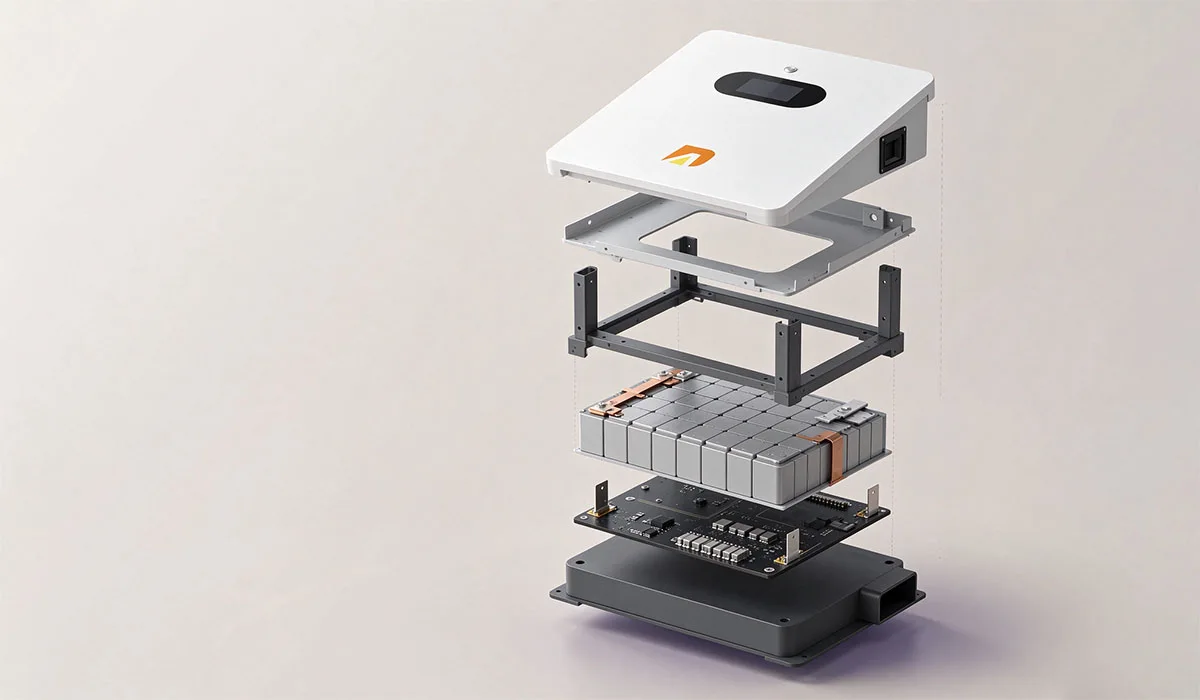
A conventional lithium-ion battery typically contains four main components:
- Cathode: The positive electrode, made from a lithium-based material such as lithium iron phosphate (LFP) or nickel manganese cobalt oxide (NMC).
- Anode: The negative electrode, commonly made from graphite or a graphite-based composite.
- Liquid electrolyte: A lithium salt dissolved in an organic solvent that allows lithium ions to move between the electrodes.
- Separator: A porous insulating layer that prevents direct contact between the positive and negative electrodes while allowing lithium ions to pass through.
During charging, lithium ions move from the cathode toward the anode. During discharging, they move in the opposite direction, releasing electrical energy to power connected equipment.
How a Solid-State Battery Works
A solid-state battery follows a similar electrochemical principle, but replaces the liquid electrolyte with a solid ion-conducting material.
Depending on the design, the solid electrolyte may also function as a separator, reducing the need for a separate porous separator layer. Some solid-state designs can use lithium-metal anodes, which have a much higher theoretical specific capacity than conventional graphite anodes.
However, the solid electrolyte must maintain effective contact with both electrodes. Poor contact, chemical reactions at the interface and mechanical changes during cycling can increase internal resistance and affect battery performance.
For a more detailed explanation of the materials, working principles and development of this technology, read our guide: What Is a Solid State Battery?
2. Solid State Battery vs Lithium-Ion Battery: Key Differences
Although both technologies store and release energy through lithium-ion movement, their internal structures and commercial characteristics are different. The following table summarizes the major differences.
| Comparison | Solid-State Battery | Conventional Lithium-Ion Battery |
|---|---|---|
| Electrolyte | Solid electrolyte | Usually liquid electrolyte |
| Separator | May be integrated into the solid electrolyte structure | Usually requires a porous separator |
| Anode materials | May use lithium metal, graphite or other designs | Commonly graphite or graphite-based materials |
| Energy density | High potential, particularly with lithium-metal anodes | Depends on cell chemistry and design; mature commercial options |
| Thermal stability | Potentially improved, depending on electrolyte and cell design | Varies by chemistry; LFP has favorable thermal stability |
| Charging performance | Fast charging is a development target; interface and conductivity limitations remain | Established charging performance with commercially available systems |
| Cycle life | Varies significantly by design; long-term commercial data is still developing | Well-established performance data across multiple chemistries |
| Manufacturing | Requires specialized materials and manufacturing processes | Mature manufacturing infrastructure and supply chains |
| Production cost | Currently faces higher manufacturing and scale-up costs | Generally more cost-competitive at commercial scale |
| Current applications | Research, development and selected emerging applications | EVs, consumer electronics, residential and commercial energy storage |
These are general technology-level comparisons, not guaranteed specifications for every battery. Performance depends on the electrolyte, electrode chemistry, cell configuration, operating temperature and manufacturing quality.
3. Energy Density: Why Solid-State Batteries Have Higher Potential
Energy density measures how much energy a battery can store relative to its weight or volume. It is an important factor in applications where battery size and weight directly affect performance, such as electric vehicles, aviation and portable electronics.
Solid-state batteries may achieve higher energy density for several reasons:
- Lithium-metal anodes: Lithium metal has a much higher theoretical specific capacity than graphite, creating an opportunity to store more energy in a smaller amount of anode material.
- Higher-voltage electrode combinations: Some solid electrolytes may support electrode materials with higher operating voltages.
- Compact cell architecture: Certain designs may reduce the amount of inactive material inside the cell.
However, higher energy density is not an automatic result of using a solid electrolyte. The actual result depends on the complete cell design, including the cathode, anode, electrolyte thickness, interface layers and packaging.
Does Higher Energy Density Always Mean a Better Battery?
Not necessarily. A battery with higher energy density can store more energy in a given weight or volume, but it may not provide the best value for every application.
For an electric vehicle, reducing battery weight can improve driving range and vehicle efficiency. For a stationary energy storage project, however, the battery usually remains in a fixed location. Project developers may place greater importance on:
- Installed cost per usable kWh;
- Expected service life and warranty conditions;
- Round-trip efficiency;
- Daily charge and discharge capability;
- Thermal management and fire protection;
- Maintenance requirements and replacement costs.
For these reasons, a mature lithium-ion battery system may offer better project economics even when its cell-level energy density is lower than the potential of an emerging solid-state design.
4. Safety: Are Solid-State Batteries Safer Than Lithium-Ion Batteries?
Safety is one of the most frequently discussed advantages of solid-state battery technology. Conventional lithium-ion batteries generally use organic liquid electrolytes, which can be flammable under certain conditions. A solid electrolyte can reduce risks associated with liquid leakage and may improve thermal and electrochemical stability.
However, it would be inaccurate to say that all solid-state batteries are completely safe or cannot experience thermal events.
Potential Safety Advantages of Solid-State Batteries
- Reduced liquid leakage risk: A fully solid electrolyte does not have the same liquid leakage mechanism as a conventional liquid-electrolyte cell.
- Potentially improved thermal stability: Some solid electrolyte materials are more thermally stable than conventional organic liquid electrolytes.
- Different separator requirements: Certain designs use the solid electrolyte as an ion-conducting barrier between electrodes.
Why Solid-State Batteries Still Have Safety Challenges
Solid-state battery safety depends on the complete cell design and the materials used. Lithium dendrite growth, mechanical cracking, interface degradation and internal short circuits remain important research topics.
Some sulfide-based solid electrolytes are also sensitive to moisture and may release hazardous hydrogen sulfide gas when exposed to water. Manufacturing, packaging and handling therefore require suitable controls.
Why Lithium Iron Phosphate Is Widely Used for Energy Storage
Among commercial lithium-ion technologies, LiFePO4 (LFP) is widely used in stationary energy storage because of its favorable thermal stability, long cycle-life potential and established manufacturing ecosystem.
Its safety performance is not based on one material alone. A reliable energy storage system also needs appropriate battery management, electrical protection, thermal monitoring, enclosure design and system-level fire protection.
For project owners, it is therefore important to evaluate the safety of the complete battery system rather than compare electrolyte materials in isolation.
5. Cycle Life and Charging Speed: Which Technology Performs Better?
Cycle life and charging speed are two important performance indicators, but neither can be judged by battery category alone.
Cycle Life
Cycle life refers to the number of charge and discharge cycles a battery can complete before its capacity falls to a specified level. The result depends on factors such as depth of discharge (DoD), operating temperature, charge and discharge rate, voltage limits and the definition of end of life.
Solid-state batteries have the potential to provide long service life, but they still face technical challenges. Repeated volume changes, cracks in solid electrolytes and degradation at electrode-electrolyte interfaces can reduce performance over time.
By comparison, commercial lithium-ion technologies have accumulated much more field experience. LiFePO4 batteries are commonly selected for stationary storage because they can support repeated cycling under suitable operating conditions.
Charging Speed
Solid-state batteries are often associated with faster charging in future applications. Their potential compatibility with lithium-metal anodes and high-voltage cathodes could support higher-performance designs.
However, fast charging is not guaranteed by a solid electrolyte. Lithium-ion transport through the electrolyte and across the electrode interface must remain sufficiently fast. High interfacial resistance and mechanical instability can limit charging performance.
Conventional lithium-ion batteries currently benefit from established cell designs, charging controls and battery management systems. Their practical charging speed depends on the specific chemistry, cell format, temperature and permitted charging rate.
6. Cost and Commercial Availability: Which Battery Is More Practical Today?
Cost and production scale are among the most important differences between solid-state and conventional lithium-ion batteries.
Solid-state batteries require specialized electrolyte materials, precise interface engineering and manufacturing processes that are different from many conventional lithium-ion production lines. Maintaining stable contact between solid materials during repeated cycling also adds engineering complexity.
These factors make large-scale production challenging. Although research and pilot manufacturing continue to advance, solid-state batteries have not yet reached the same level of broad commercial deployment as conventional lithium-ion batteries.
Conventional lithium-ion batteries benefit from decades of investment in cell manufacturing, material supply chains, quality control and system integration. This maturity supports more predictable production costs and wider availability.
| Commercial Factor | Solid-State Battery | Conventional Lithium-Ion Battery |
|---|---|---|
| Manufacturing scale | Still developing for many designs | Established global production capacity |
| Supply chain | Specialized materials and processes | Mature material and component supply chains |
| Product availability | More limited and design-dependent | Widely available across multiple applications |
| Price predictability | Still affected by scale-up and process development | Generally more predictable at commercial scale |
| Project procurement | Requires careful verification of production and field data | More established product specifications and deployment experience |
For energy storage buyers, the relevant question is not simply which battery has the most advanced chemistry. It is whether the supplier can provide a complete system with verified specifications, certifications, warranty coverage, installation support and long-term service.
7. Solid-State Battery vs LiFePO4: What Is the Difference?
This comparison is particularly important for solar energy storage buyers because the terms “solid-state battery” and “LiFePO4 battery” describe different aspects of battery technology.
LiFePO4 refers to lithium iron phosphate, a cathode chemistry. Solid-state refers to the physical form of the electrolyte. Therefore, they are not directly opposite battery categories.
A solid-state battery may use a lithium-based cathode material, while a conventional commercial LiFePO4 battery generally uses a liquid electrolyte. The comparison below focuses on the typical commercial LFP battery used in stationary energy storage and the emerging solid-state battery concept.
| Feature | Solid-State Battery | Commercial LiFePO4 Battery |
|---|---|---|
| Technology classification | Solid electrolyte architecture | Lithium iron phosphate cathode chemistry, usually with liquid electrolyte |
| Energy density | Higher potential in some advanced designs | Generally lower than high-energy lithium-metal solid-state targets |
| Thermal characteristics | Depends on electrolyte and complete cell design | Favorable thermal stability compared with many other lithium-ion chemistries |
| Cycle-life evidence | Still developing across commercial designs | Extensive commercial operating experience |
| Commercial maturity | Emerging technology | Established energy storage technology |
| Typical suitability | Applications seeking future high-energy-density solutions | Residential storage, commercial storage and stationary backup power |
Why LiFePO4 Is a Practical Choice for Stationary Energy Storage
For stationary energy storage, the battery does not need to be as lightweight as an EV battery. Instead, project owners often need a balance of usable energy, service life, safety, installation cost and system reliability.
LiFePO4 technology offers several practical advantages:
- Thermal stability: LFP chemistry has favorable thermal characteristics for stationary applications.
- Long cycle-life potential: Properly designed LFP cells can support repeated charging and discharging over many years.
- Established manufacturing: Commercial suppliers can provide a range of capacities, voltage configurations and system designs.
- System integration: LFP battery packs can be integrated with BMS, PCS, inverters and energy management systems.
- Scalability: Modular designs can support residential installations as well as larger commercial and industrial energy storage projects.
For buyers evaluating a storage system, these factors can be more important than pursuing the highest theoretical cell energy density.
8. Which Battery Technology Is Better for Residential and Commercial Energy Storage?
The right choice depends on the project’s operating requirements, installation environment and procurement timeline.
Residential Solar Energy Storage
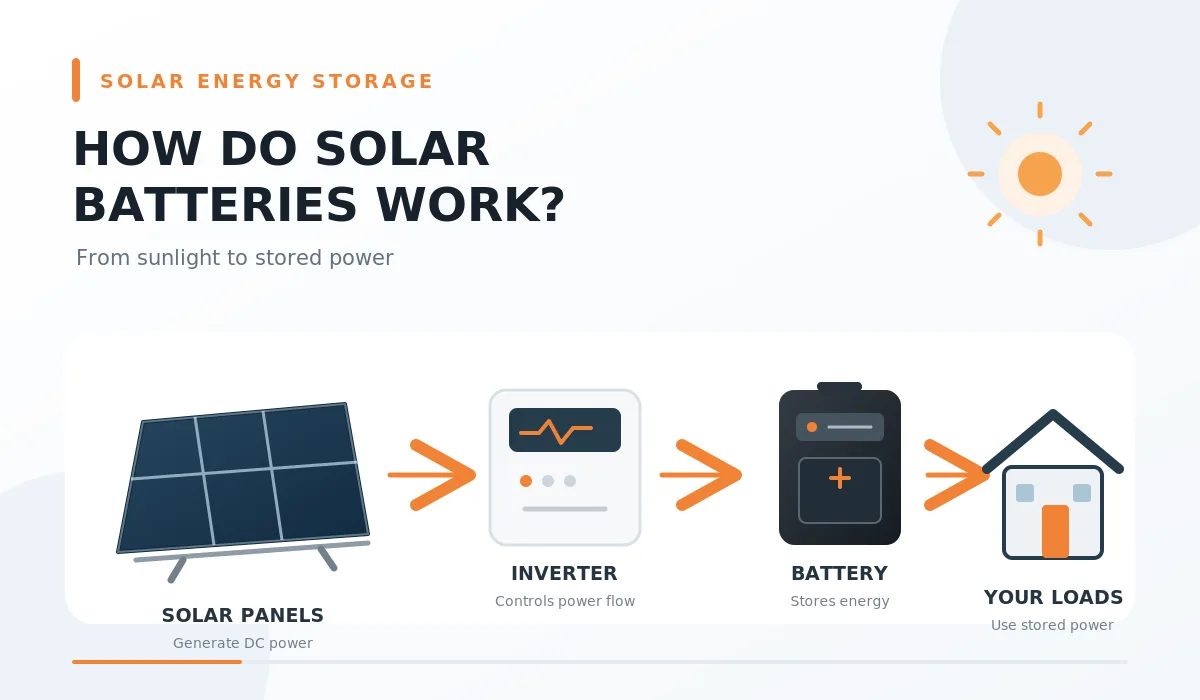
Residential systems store electricity generated by rooftop solar panels for use at night, during peak electricity-price periods or when the grid is unavailable.
For most residential projects that need a commercially available product today, LiFePO4 batteries are a practical option. Buyers should compare usable capacity, inverter compatibility, continuous charge and discharge power, operating temperature, safety protection and warranty conditions.
Battery energy capacity alone is not enough to determine whether a system meets household requirements. The inverter, load profile and expected backup duration must also be considered.
Commercial and Industrial Energy Storage
Commercial and industrial energy storage systems are used for applications such as:
- Peak shaving and demand-charge management;
- Solar self-consumption and energy shifting;
- Backup power for factories and commercial buildings;
- Power supply for remote sites and weak-grid locations;
- Energy management for charging stations and distributed energy projects.
In these applications, system-level performance matters. A project developer should evaluate battery capacity, usable energy, PCS power, operating voltage, cycle-life conditions, thermal management, protection design, communication protocols and the supplier’s after-sales capabilities.
For larger projects, the ability to expand battery capacity and integrate multiple units is also important. A system should be designed around the site’s load profile, grid conditions and expected operating strategy rather than selected only by nominal battery capacity.
A Practical Procurement Checklist
Before choosing between battery technologies, project owners and EPC contractors should confirm the following information with the supplier:
- Is the quoted battery fully solid-state, semi-solid-state or conventional liquid-electrolyte lithium-ion?
- What is the cell chemistry and electrolyte composition?
- Is the stated capacity nominal energy or usable energy?
- What are the charge and discharge power limits?
- Under what temperature, DoD and C-rate conditions is cycle life specified?
- What certifications are available for the cell, battery pack and complete system?
- What BMS protections and system-level fire protection measures are included?
- What warranty terms, technical support and spare-parts arrangements are provided?
- Can the supplier provide references from comparable installations?
These questions help buyers distinguish between laboratory performance claims, cell-level specifications and the actual performance of a complete energy storage system.
9. Will Solid-State Batteries Replace Lithium-Ion Batteries?
Solid-state batteries are an important area of battery research and industrial development. They may become increasingly relevant in applications where higher energy density, compact design and improved thermal characteristics justify the additional manufacturing complexity.
However, replacing conventional lithium-ion batteries across all applications is not a simple or immediate process.
Several technical and commercial challenges still need to be addressed:
- Interface stability: Maintaining low-resistance contact between solid electrolytes and electrodes during repeated cycling.
- Manufacturing consistency: Producing cells with uniform electrolyte layers, reliable interfaces and consistent quality at scale.
- Material costs: Reducing the cost of specialized electrolyte materials and processing methods.
- Long-term durability: Demonstrating reliable performance under realistic operating conditions over extended periods.
- Supply-chain development: Building stable sources for materials, equipment and production capacity.
Conventional lithium-ion batteries will therefore continue to play an important role in energy storage while solid-state technologies develop. Different battery technologies may serve different applications rather than one technology completely replacing another.
For stationary storage, the commercial value of a battery depends on its total operating cost, reliability, safety design and suitability for the project. A new battery architecture must demonstrate these benefits in real installations before it can become a practical replacement for established products.
10. Frequently Asked Questions
1. What is the main difference between a solid-state battery and a lithium-ion battery?
The main difference is the electrolyte. Conventional lithium-ion batteries generally use a liquid electrolyte, while solid-state batteries use a solid electrolyte to transport lithium ions. This changes the cell structure and can affect energy density, thermal stability, manufacturing and cost.
2. Are solid-state batteries better than lithium-ion batteries?
Not in every application. Solid-state batteries have the potential to provide higher energy density and improved thermal stability, but they still face challenges in manufacturing scale, cost and long-term performance. Conventional lithium-ion batteries currently offer greater commercial maturity and availability.
3. Are solid-state batteries safer than lithium-ion batteries?
Some solid electrolytes can reduce risks associated with liquid electrolyte leakage and may offer improved thermal stability. However, solid-state batteries can still experience issues such as lithium dendrite formation, interface degradation and mechanical failure. Safety depends on the complete cell and system design.
4. Do solid-state batteries use lithium?
Yes. Many solid-state battery designs are lithium-based. The term “solid-state” refers to the solid electrolyte rather than the absence of lithium. Some designs also use lithium-metal anodes to increase potential energy density.
5. Is LiFePO4 a solid-state battery?
No. LiFePO4 describes the lithium iron phosphate cathode chemistry. Most commercially available LiFePO4 batteries use liquid electrolytes, so they are conventional lithium-ion batteries rather than fully solid-state batteries.
6. Do solid-state batteries have a longer cycle life?
Not necessarily. Cycle life depends on the cell design, materials, operating temperature, depth of discharge and charging conditions. Solid-state batteries have long-term potential, but commercial lithium-ion technologies currently have more extensive field-performance data.
7. Are solid-state batteries commercially available?
Some solid-state and semi-solid-state products and pilot-scale applications are emerging, but availability varies by technology and manufacturer. Fully solid-state batteries have not yet achieved the same broad commercial scale as conventional lithium-ion batteries.
8. Which battery is better for solar energy storage?
For many residential and commercial solar storage projects that require proven products and established supply chains, LiFePO4 batteries are a practical choice. Buyers should compare usable capacity, cycle-life conditions, system safety, warranty, inverter compatibility and total installed cost.
Conclusion: Choose Battery Technology Based on the Application
The comparison between solid state battery vs lithium ion battery shows that each technology has different strengths. Solid-state batteries offer promising opportunities for higher energy density and improved thermal characteristics, but their manufacturing processes, interface stability and commercial costs still need further development.
Conventional lithium-ion batteries benefit from established production capacity, mature supply chains and extensive application experience. Within this category, LiFePO4 remains a practical option for many residential and commercial energy storage projects because of its thermal characteristics, cycle-life potential and commercial availability.
For energy storage buyers, the best battery is not necessarily the one with the most advanced laboratory specifications. It is the one that meets the project’s requirements for usable energy, safety, operating life, cost and long-term support.
Looking for a Reliable LiFePO4 Energy Storage Solution?
Dawnice provides residential and commercial energy storage solutions based on LiFePO4 battery technology. Our product range covers household storage and larger C&I applications, with scalable configurations for different project requirements.
Whether you are an EPC contractor, distributor, project developer or commercial energy user, our team can help you evaluate battery capacity, system configuration and application requirements.
Explore Dawnice High Voltage Battery Systems | Contact Dawnice for an Energy Storage Solution
Technical reading: Challenges in speeding up solid-state battery development, Nature Energy; Comparing the energy and climate impacts of conventional lithium-ion and all-solid-state batteries, EES Batteries.