How Do Solar Batteries Work? Solar Storage Guide
How Do Solar Batteries Work? Solar Storage Guide
How Do Solar Batteries Work? From Sunlight to Stored Power
How do solar batteries work? They store surplus electricity generated by solar panels as chemical energy inside battery cells. An inverter controls how electricity moves between the solar panels, battery, grid, and connected loads. When solar production drops, the battery releases its stored energy to power your home or business.
That’s the basic idea. Generate electricity during the day. Keep what you don’t immediately need. Use it when the sun goes down.
But there is more happening inside a solar energy storage system than most people realize. Battery chemistry, inverter configuration, charging limits, temperature, and power demand all affect how well the system performs. Let’s follow the electricity from the solar panels to the battery, then back to the equipment that needs it.
How Do Solar Batteries Work? The Basic Process Explained
A solar battery doesn’t produce electricity. It stores electricity that another source has already generated. In a solar-plus-storage system, that source is usually a photovoltaic (PV) array installed on a roof, carport, or open site.
Here is the typical energy flow:
Sunlight → Solar Panels → Inverter → Electrical Loads → Battery Charging → Stored Energy → Battery Discharging → Electrical Loads.
The exact route depends on whether the installation uses AC coupling or DC coupling. We’ll get to that in a moment.
Step 1: Solar Panels Generate Electricity
Everything starts with sunlight hitting photovoltaic cells inside the solar panels.
These cells are made from semiconductor materials, usually silicon. When sunlight reaches the cells, it transfers energy to electrons and helps create an electric current. This is known as the photovoltaic effect.
The electricity produced by solar panels is direct current (DC). It travels in one direction, which makes it suitable for battery charging and DC electrical systems.
There is one practical detail worth remembering. Solar production changes throughout the day. A bright afternoon may produce considerably more electricity than a cloudy morning. Panel temperature, shading, orientation, and system conditions also affect output.
Step 2: The Inverter Manages Electricity Conversion
Most household and commercial electrical equipment runs on alternating current (AC), while solar panels and battery cells operate with DC electricity.
That’s where the inverter comes in.
A solar inverter converts DC electricity from the PV array into AC electricity for the building. A hybrid inverter can also manage battery charging and discharging, coordinating energy movement between the panels, battery, grid, and loads.
Think of the inverter as the traffic controller of the installation. It decides where available power should go according to the system configuration and operating settings.
In a typical installation, solar generation first serves the active electrical loads. When production exceeds consumption, the remaining energy can charge the battery. The exact priority can be adjusted through the energy management settings.
Step 3: Excess Solar Electricity Charges the Battery
Now let’s look at the solar battery charging process.
Imagine a factory operating during the afternoon. Its solar panels are generating 80 kW, while the building is consuming 55 kW at that moment.
There are approximately 25 kW of surplus solar generation available. Depending on the inverter rating, battery charging limits, and energy management settings, this surplus can be directed into the battery instead of being exported to the electricity grid.
Inside the battery, electrical energy is converted into chemical energy through electrochemical reactions. The battery stores that energy until the system needs it.
The charging current isn’t simply pushed into the cells without control. The inverter and Battery Management System work together to keep charging within the permitted voltage, current, and temperature limits.
Step 4: Stored Energy Powers Equipment When Solar Production Falls
At sunset, solar generation drops. During the night, it eventually reaches zero.
This is when the battery becomes useful.
Stored DC electricity flows from the battery through the inverter, which converts it into AC electricity for connected appliances, lighting, machinery, or other electrical loads.
The grid can supplement the supply when battery energy is insufficient. In an off-grid installation, a generator may perform this role.
One important point: a battery does not automatically provide unlimited electricity. Its usable capacity and maximum discharge power determine how much equipment it can support and for how long.
What Happens Inside a Solar Battery When It Stores Energy?
Understanding the external energy flow is easy enough. The more interesting part is what happens inside the battery cells.
How Lithium-Ion Battery Cells Store Electricity
Most modern stationary solar energy storage systems use lithium-ion battery technology. Among these, lithium iron phosphate (LFP) is a widely used chemistry.
An LFP cell contains several main elements:
- Cathode: The positive electrode, made from lithium iron phosphate in an LFP cell.
- Anode: The negative electrode, commonly made from graphite.
- Electrolyte: A medium that allows lithium ions to move between the electrodes.
- Separator: A thin insulating layer that prevents direct contact between the electrodes while allowing ion movement.
During charging, lithium ions move through the electrolyte from one electrode toward the other. Electrons travel through the external electrical circuit, driven by the charging equipment.
During discharge, the electrochemical reaction reverses. Electrons flow through the connected electrical load and provide usable power.
It is a repeatable process. The cell can charge and discharge thousands of times, although its available capacity gradually decreases with use and age.
Why LFP Batteries Are Common in Solar Energy Storage
Not all lithium batteries use the same chemistry. LFP and nickel manganese cobalt (NMC) are two established lithium-ion options.
For stationary energy storage, LFP is often selected because of its thermal stability, long service potential, and suitability for repeated charging and discharging.
Here is a practical comparison:
| Comparison | LFP Battery | NMC Battery | Lead-Acid Battery |
|---|---|---|---|
| Chemistry | Lithium iron phosphate | Nickel manganese cobalt | Lead and sulfuric acid |
| Thermal stability | Generally higher | Requires careful thermal management | Different heat and ventilation requirements |
| Energy density | Moderate | Generally higher | Generally lower |
| Cycle life | Generally long under suitable operating conditions | Depends on cell design and operating conditions | Generally shorter in deep-cycle applications |
| Typical application | Residential, commercial and industrial storage | Applications where compact size matters | Traditional backup and selected off-grid systems |
| Common selection advantage | Strong fit for stationary energy storage | Higher energy density | Established technology and initial cost options |
There is no battery chemistry that wins every project. However, when a system is expected to cycle frequently over many years, LFP is often a sensible starting point for stationary storage.
The Main Components of a Solar Battery Storage System
A battery pack is only one part of a working energy storage installation. Remove the supporting equipment and the system cannot operate as intended.
1. Battery Cells and Battery Packs
Individual cells are connected in series and parallel to reach the required voltage and capacity. These cells are assembled into modules or packs, depending on the battery architecture.
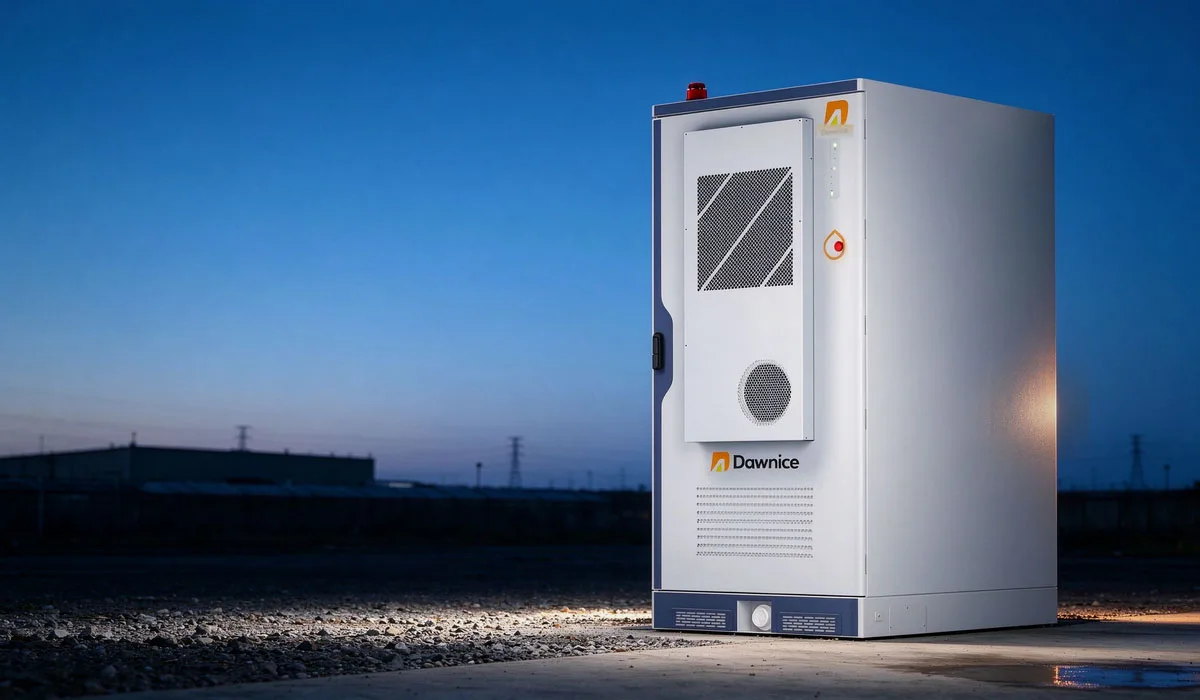
For example, a larger commercial battery cabinet may contain multiple battery modules connected to form a higher-capacity energy storage unit.
Cell matching, connection quality, busbar design, insulation, and mechanical assembly all affect the final product.
2. Battery Management System (BMS)
The battery management system (BMS) is responsible for monitoring and protecting the battery.
It keeps track of cell voltage, current, temperature, and state of charge. Depending on the battery design, it also manages cell balancing, contactors, alarms, and protective shutdowns.
For example, imagine one cell reaches its permitted upper voltage limit before the others. The BMS can restrict or stop charging to prevent the battery from operating outside its specified limits.
A good BMS doesn’t magically fix poor-quality cells or bad installation work. It is one part of a properly engineered battery system.
3. Solar or Hybrid Inverter
The inverter converts DC electricity into AC electricity and, in compatible systems, manages the charging and discharging power flow.
When selecting an inverter, check its battery voltage range, continuous charge and discharge power, communication protocol, and compatibility with the battery manufacturer’s equipment.
A battery rated at 100 kWh does not mean it can automatically discharge at 100 kW. Energy capacity and power output are two different specifications.
4. Energy Management System (EMS)
The EMS coordinates how the entire installation uses available energy.
It can monitor solar generation, battery state of charge, grid imports, export power, and electrical demand. In commercial installations, it may also schedule battery charging and discharging according to time-of-use electricity rates or peak demand targets.
Remember the distinction: the BMS manages the battery itself. The EMS manages energy at the system level.
DC-Coupled vs AC-Coupled Solar Battery Systems
This is one of the first questions we discuss when evaluating a new battery project or retrofitting an existing solar installation.
Both configurations work. The difference is how electricity travels between the solar panels, inverter, battery, and electrical loads.
How Does a DC-Coupled Battery System Work?
In a DC-coupled battery system, the solar panels and battery are connected on the DC side of a compatible hybrid inverter.
Solar panels generate DC electricity. When there is surplus production, the hybrid inverter’s power electronics manage the charging path and direct suitable DC power into the battery.
When the building needs electricity, the inverter converts DC power from the battery into AC power for the connected loads.
Because solar electricity can charge the battery without first going through a separate AC conversion stage, DC coupling can reduce conversion stages in the solar-to-battery charging path.
How Does an AC-Coupled Battery System Work?
An AC-coupled battery system uses a separate battery inverter alongside the existing solar inverter.
First, the solar inverter converts PV electricity from DC into AC. Any surplus electricity then travels through the AC electrical system to the battery inverter, which converts it back into DC to charge the battery.
When the battery discharges, the process runs in the opposite direction. The battery inverter converts stored DC energy into AC electricity for the building.
Yes, there is another conversion stage. But AC coupling can be a practical solution when a customer already has a working grid-connected solar installation and wants to add storage without replacing the original solar inverter.
| Comparison | DC-Coupled | AC-Coupled |
|---|---|---|
| Main equipment | Hybrid inverter | Solar inverter and battery inverter |
| Solar-to-battery route | PV DC to battery through DC-side power electronics | PV DC to AC, then AC to battery DC |
| Best suited for | Many new solar-plus-storage installations | Adding storage to existing solar systems |
| Conversion stages | Fewer conversion stages on the direct solar charging path | Additional DC/AC conversion stages |
| Existing PV compatibility | May require inverter replacement or redesign | Often allows the existing PV inverter to remain |
| Main design consideration | Hybrid inverter and battery compatibility | AC bus integration and inverter coordination |
So which one should you choose?
For a new installation, DC coupling is worth evaluating. For an existing solar system, AC coupling may be the simpler retrofit. Actual efficiency and cost depend on inverter topology, operating conditions, and system design. There is no universal winner.
How Long Can a Solar Battery Power Your Home or Business?
Here is where battery specifications start to matter.
Two measurements are often confused: kW and kWh.
Understand Battery Power (kW) and Capacity (kWh)
- kW (kilowatt): Measures power. It tells you how much electricity a battery system can deliver at a given moment.
- kWh (kilowatt-hour): Measures energy. It tells you how much electricity the battery can store or deliver over time.
Think about a water tank. kWh represents the amount of water inside, while kW represents how quickly that water can flow out.
A 100 kWh battery paired with a 50 kW inverter has a nominal two-hour discharge duration at full rated output, before accounting for usable capacity, conversion losses, and operating limits.
Now let’s calculate a real project requirement.
A Practical Battery Capacity Calculation
Imagine a small production workshop needs 20 kW of electrical power for three hours after solar generation drops.
The required delivered energy is:
20 kW × 3 hours = 60 kWh.
But ordering a 60 kWh battery would be too optimistic. We need to account for the usable depth of discharge and inverter efficiency.
Assume the following design figures:
- Required AC energy: 60 kWh.
- Battery depth of discharge: 90%.
- Discharge conversion efficiency: 95%.
The approximate nominal battery capacity required is:
60 ÷ (0.90 × 0.95) = 70.2 kWh.
That means a battery system of approximately 70.2 kWh is the mathematical starting point under these assumptions. In practice, an engineer may specify a larger capacity to accommodate operating reserves, ageing, temperature effects, and changing loads.
And don’t forget the inverter. It must support at least 20 kW of continuous AC output, as well as the starting demand of any motors or compressors connected to the system.
That last detail matters. A battery may have enough stored energy but still fail to start a machine if its power output is too low.
What Happens When a Solar Battery Is Full or Empty?
These are two simple questions, but they reveal a lot about how an energy storage system is configured.
What Happens When the Battery Reaches 100% Charge?
Once the battery reaches its permitted upper state of charge, the BMS and inverter limit or stop further charging.
The solar panels don’t have to stop producing electricity. Instead, the energy management system can redirect the remaining surplus to the grid, send it to another compatible load, or curtail PV production when export is restricted and no other load is available.
Nothing unusual needs to happen. The system simply follows its configured energy management rules.
What Happens When the Battery Is Empty?
When the battery reaches its configured minimum state of charge, the inverter stops or limits battery discharge according to its settings.
In a grid-connected system, electricity can then come from the utility grid. In an off-grid system, a properly configured generator or another available power source may be needed.
This is why choosing the right usable capacity is more important than simply looking at the battery’s advertised nominal capacity.
Do Solar Batteries Work During a Power Outage?
Yes, but there is an important condition.
A standard grid-connected solar inverter normally shuts down when the public grid fails. This is an anti-islanding safety measure. It prevents the solar installation from continuing to energize utility lines that workers may believe are disconnected.
Adding a battery alone does not automatically solve this problem.
What Is Required for Backup Power?
A system designed for blackout protection typically needs:
- Compatible inverter: The inverter must support backup or islanded operation.
- Grid isolation: An approved transfer or isolation arrangement disconnects the property from the public grid during an outage.
- Battery capacity: Enough usable stored energy to support the intended backup period.
- Sufficient output power: The inverter and battery must handle the connected loads, including equipment starting currents.
- Correct electrical protection: Appropriate breakers, cabling, earthing, and installation protection.
Some systems support essential-load backup only. Others are designed for whole-building backup, depending on the inverter rating, battery capacity, electrical architecture, and local regulations.
For a factory, you may only need to protect the control system, security equipment, communications, and selected production processes. Keeping every machine running during a blackout is a very different engineering and financial decision.
What Affects Solar Battery Performance and Lifespan?
Battery capacity is only one part of the equation. A good storage system must also work within the electrical and environmental conditions of the installation.
Depth of Discharge (DoD)
Depth of discharge tells you how much of the battery’s nominal capacity has been used.
For example, a 100 kWh battery operating at 90% DoD provides approximately 90 kWh of battery-side usable energy under the specified conditions.
A higher usable depth of discharge can provide more available energy from the same nominal capacity. However, the manufacturer’s permitted operating range should always be followed.
Round-Trip Efficiency (RTE)
Round-trip efficiency measures how much energy you can recover compared with the amount used to charge the battery.
Suppose a battery system receives 100 kWh during charging and returns 94 kWh after a complete charge-and-discharge cycle. Its measured round-trip efficiency is 94% under that test condition.
The remaining energy is lost through internal battery processes, power conversion, and system auxiliary consumption. Always compare efficiency figures measured under equivalent test conditions.
Operating Temperature
Temperature affects battery performance and ageing. Excessive heat can accelerate degradation, while low temperatures may restrict charging and discharging.
This is especially relevant in hot regions where energy storage cabinets are installed outdoors. Proper ventilation, thermal management, cabinet design, and suitable operating limits should be included in the original system design.
Charge and Discharge Rate
Battery C-rate describes charging or discharging current relative to the battery’s rated capacity.
A battery with a high energy capacity does not necessarily support a high charging or discharging rate. Cell specifications, module configuration, BMS limits, and inverter ratings all have to match.
For a commercial project with high morning demand and a short solar charging window, this specification can be just as important as nominal capacity.
How Solar Battery Storage Works in Commercial and Industrial Applications
The operating principle is the same for a house and a factory. The difference is the size and behavior of the electrical loads.
A residential user may want to store enough electricity for evening lighting, refrigeration, and air conditioning. A factory may need to manage several production lines, pumps, compressors, HVAC equipment, and fluctuating demand throughout the working day.
Peak Shaving for Factories
Consider a manufacturing facility where several machines start operating at the same time every morning.
Its grid demand may rise sharply for a short period. Depending on the electricity tariff, that peak can increase the monthly electricity bill.
A properly sized battery energy storage system can discharge during selected high-demand periods and reduce the amount of power imported from the grid.
This is known as peak shaving.
However, a battery must be sized around the actual load profile. A 100 kWh battery with insufficient discharge power may not reduce a 200 kW demand spike as much as the customer expects.
Solar Energy Storage for Warehouses and Commercial Buildings
Warehouses often have a different consumption pattern from production facilities.
During the day, rooftop solar can supply lighting, ventilation, office equipment, and selected machinery. If electricity generation exceeds demand, the battery stores the surplus for later consumption.
At night or during periods of low solar production, stored energy can support the building and reduce grid imports.
Depending on local tariff structures, the system may also use scheduled grid charging during cheaper electricity periods. This requires compatible equipment and careful control settings.
For commercial buyers, the real question isn’t just how many kilowatt-hours a battery can store. It’s how those kilowatt-hours match the building’s actual demand, tariff, and operating schedule.
How to Choose a Reliable Solar Battery Manufacturer
Understanding how a solar battery works is one thing. Choosing the equipment that will operate reliably for years is another.
When evaluating a battery supplier, don’t stop at the product brochure. Ask for the technical documents and check whether the specifications match your project.
Check the Battery Specifications
- Cell chemistry: Confirm whether the battery uses LFP, NMC, or another chemistry.
- Cell manufacturer and traceability: Request information about cell origin, grading, and quality control.
- Nominal and usable capacity: Make sure both figures are clearly stated.
- Continuous and peak power: Check the permitted charge and discharge power, including surge duration.
- Battery voltage: Verify compatibility with the selected inverter and system architecture.
- Cycle life and warranty: Read the actual test conditions, warranted capacity retention, throughput limits, and warranty exclusions.
- Communication: Confirm whether the battery supports the inverter’s communication protocol and monitoring requirements.
Verify Manufacturing Quality and Compliance Documents
A professional battery manufacturer should be able to explain its production quality controls and provide documentation relevant to the target market and battery model.
For an overseas project, the paperwork deserves attention before shipment, not after the container reaches the port.
- CE documentation: Check applicable European conformity requirements and the exact product model covered.
- IEC test reports: Verify the relevant battery and energy storage standards applicable to the equipment and installation.
- UN 38.3: Check the applicable lithium battery transport test documentation and model identification before arranging shipment.
- MSDS: Review the material safety information required by the relevant logistics and handling parties.
- Quality inspection: Ask about incoming cell inspection, production testing, insulation checks, and final product testing.
One more practical point. A certificate bearing a supplier’s name isn’t enough. Check the manufacturer, exact model, report scope, issuing body, and document validity. Transport documentation is also not a substitute for local electrical installation approval.
Good documentation makes international procurement easier and helps reduce unpleasant surprises during customs clearance, installation, and project commissioning.
Frequently Asked Questions About How Solar Batteries Work
1. Can Solar Batteries Work Without Solar Panels?
Yes. A compatible battery system can be charged from the electricity grid or a generator, depending on its inverter and charging capabilities. However, without a solar energy source, it cannot generate renewable electricity itself. It simply stores electricity supplied by another source.
2. Do Solar Batteries Charge on Cloudy Days?
Yes. Solar panels can still generate electricity when sunlight is reduced by clouds, although their output is usually lower. The available charging power depends on actual PV generation, current electrical consumption, and battery charging limits.
3. Can Solar Batteries Be Charged at Night?
Yes, provided the system supports grid charging or generator charging. Some installations use cheaper off-peak electricity to recharge their batteries overnight. This depends on inverter functionality, battery compatibility, tariff arrangements, and local regulations.
4. How Many Hours Can a Solar Battery Last?
It depends on usable battery capacity and connected electrical demand. For example, a battery delivering 10 kWh of usable AC energy can theoretically support a 2 kW load for five hours. Actual backup time may be shorter because of conversion losses, auxiliary consumption, reserve settings, and changes in load demand.
5. Are Solar Batteries Safe to Install Indoors?
Some battery models are approved for suitable indoor installations, while others require outdoor or specifically designed installation locations. Always follow the manufacturer’s installation instructions, local fire and electrical regulations, ventilation requirements, and clearance specifications. Never assume every battery cabinet can be installed in the same location.
6. Do Solar Batteries Need an Inverter?
Most solar battery storage systems require power conversion equipment to operate with standard AC electrical loads. Some products have an integrated inverter, while others use an external hybrid or battery inverter. The correct configuration depends on the system design and intended application.
Looking for a Solar Battery Manufacturer for Your Next Project?
Now you know how solar batteries work, from photovoltaic power generation and electrochemical storage to inverter conversion and controlled discharge.
The next step is matching the technology to your actual energy requirements.
Whether you’re a solar installer, distributor, EPC contractor, or industrial energy buyer, choosing the right battery configuration requires more than comparing prices per kWh.
You need to look at usable capacity, charging and discharging power, battery chemistry, inverter compatibility, installation conditions, and long-term technical support.
Dawnice works with energy storage requirements across residential, commercial, and industrial applications. Our team can help discuss battery configurations based on your project specifications and application requirements.
Planning a new solar-plus-storage project? Send us the following information so we can better understand your requirements:
- Application: Residential, commercial, industrial, or off-grid.
- Required capacity: For example, 15 kWh, 50 kWh, 100 kWh, or larger.
- Power requirements: Continuous output and peak load demand.
- System voltage: Low-voltage or high-voltage configuration.
- Inverter information: Brand, model, and communication compatibility.
- Destination: Country and intended installation market.
Our team can review your requirements and discuss a suitable energy storage solution.
Contact Dawnice today to discuss your solar battery project and request a customized quotation.