How to Charge LiFePO4 Correctly: Complete Guide & Charger Selection
How to Charge LiFePO4 Correctly: Complete Guide & Charger Selection
Charging is where most LiFePO4 problems actually begin. The wrong lifepo4 battery charger — or the right charger programmed with the wrong voltages — shortens cycle life, trips BMS protection, and quietly leaves a commercial installation running at 80% of its rated capacity. For solar installers, EPC contractors and facility managers, those failures surface on site as commissioning delays, service callouts and warranty disputes, not as spec-sheet footnotes.
This guide explains how to charge a lifepo4 battery correctly: the CC-CV profile, exact voltage and current settings for 48V and 51.2V packs, charge-time math, and what to specify when you buy a 48v lifepo4 battery charger for a project. Every value below sits inside the cell’s safe operating window — 3.2V nominal, 3.65V absolute maximum per cell — so the same rules apply whether you commission a single 5kWh cabinet or a 200kWh solar site. By the end of this guide you should be able to spec a charger, program a charge controller, and commission a pack on the first try — without guessing at settings.
LiFePO4 Charging Basics: CC-CV Explained
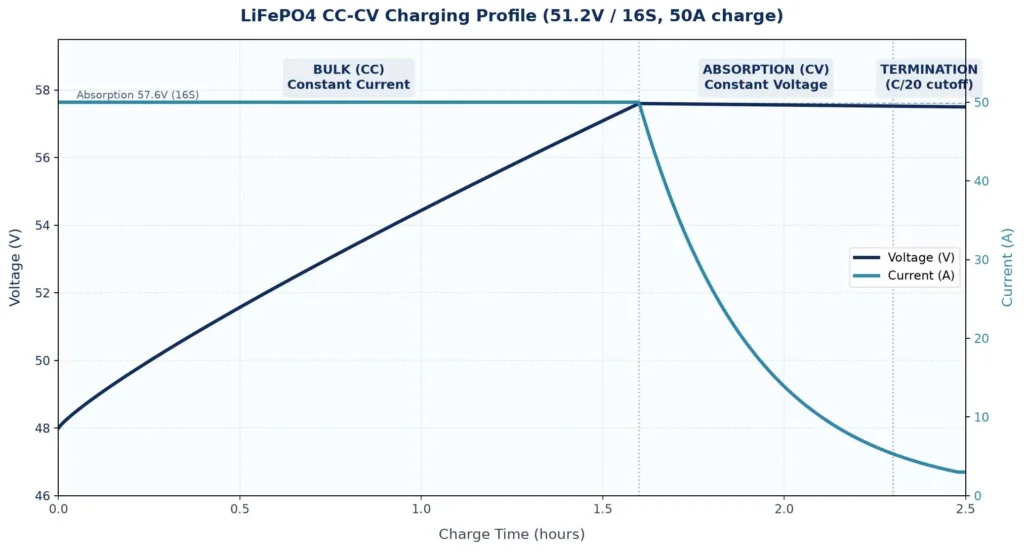
LiFePO4 cells charge through a constant current / constant voltage (CC-CV) profile. Understanding the two phases is the foundation of how to charge lifepo4 battery systems correctly — and it is why charger settings matter more than the charger brand.
Bulk phase (constant current). The charger delivers a fixed current while cell voltage rises from about 3.2V toward the absorption setpoint. This phase restores roughly 80% of the pack’s usable capacity and is where most of the energy transfer happens.
Absorption phase (constant voltage). Voltage is held at the absorption setpoint — typically 3.4–3.5V per cell — while current tapers as the cells fill. The closer the current gets to zero, the closer the pack is to full.
Termination. Charging stops when current falls to a threshold such as 0.05C (C/20) or when the BMS reports full state of charge. A proper lifepo4 battery charger terminates cleanly; many lead-acid chargers do not.
Two settings should never be applied to a lithium iron phosphate pack: float voltage and equalization. LiFePO4 does not need a continuous float charge to stay healthy, and equalization pulses push cells past their voltage limit. Float keeps a lead-acid bank topped up; on LiFePO4 it holds cells at high state of charge indefinitely and accelerates aging. Disable both on any charger or charge controller you commission.
The Correct LiFePO4 Charging Voltage (12V / 24V / 48V / 51.2V)
Voltage mismatch is the most common charger failure in the field. The correct lifepo4 charge voltage is set by cell count, not by the label printed on the battery. Each LiFePO4 cell runs 3.2V nominal with an absolute maximum of 3.65V, and most manufacturers recommend an absorption window of 3.4–3.5V per cell — the balance between usable capacity and cycle life. The lifepo4 charging voltage for a pack is simply the per-cell value multiplied by the number of cells in series.
| System | Cells | Nominal Voltage | Max Charge Voltage (3.65V/cell) | Recommended Absorption (3.4–3.5V/cell) |
|---|---|---|---|---|
| 12V | 4S | 12.8V | 14.6V | 13.6–14.0V |
| 24V | 8S | 25.6V | 29.2V | 27.2–28.0V |
| 48V (15S) | 15S | 48.0V | 54.75V | 51.0–52.5V |
| 51.2V (16S) | 16S | 51.2V | 58.4V | 54.4–56.0V |
The “48V” naming trap: 15S versus 16S. A true 48V pack uses 15 cells in series (48.0V nominal) and tops out at 54.75V. Most modern commercial “48V” packs — including Dawnice’s low-voltage series — use 16 cells, run at 51.2V nominal, and are rated for a working window of 44.8–57.6V. Charge a 16S pack with a 15S profile and it stops at roughly 94% full, permanently short-changing the customer. Charge a 15S pack with a 16S profile and you push cells toward overvoltage and repeated BMS trips.
For 16S packs, 57.6V (3.6V per cell) is a practical absorption ceiling, and 58.4V (3.65V per cell) is the hard limit that should never be programmed into a charger.
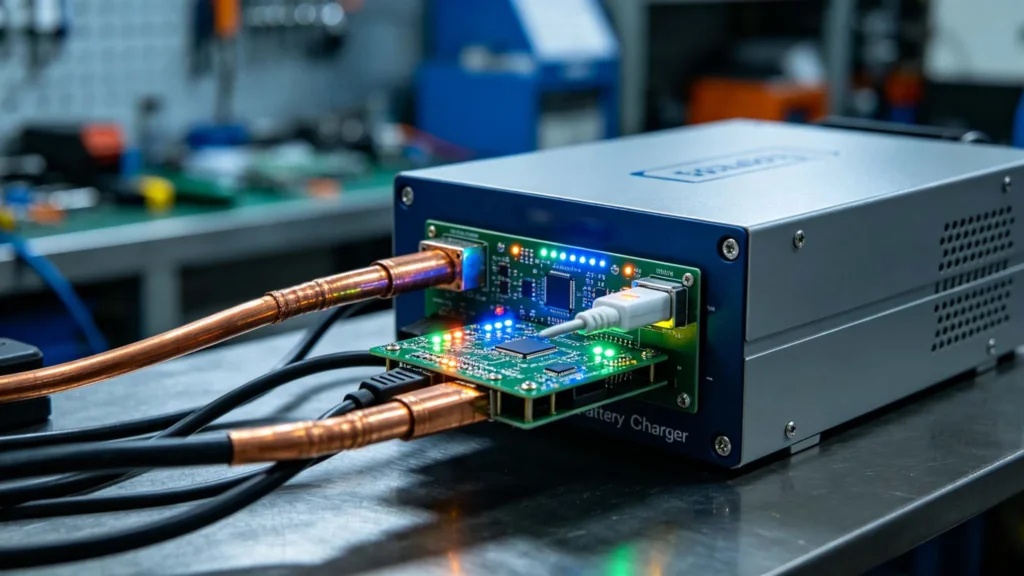
Charging Current: How Many Amps Is Safe?
The best charging current for lifepo4 is a function of pack capacity and BMS limits, and the safe rule of thumb is 0.2C–0.5C. C-rate is simply charge current divided by capacity: a 100Ah pack charged at 50A is a 0.5C charge; at 20A it is 0.2C.
- 100Ah pack → 20–50A recommended; 100A (1C) is the absolute maximum, and only if the BMS allows it.
- 200Ah pack → 40–100A recommended; above that, cell heating and BMS stress rise quickly.
Oversizing the charger is a common procurement mistake: a bigger charger is not a safer one. Excess current stresses the cells and the BMS current path, raises temperature, and accelerates capacity fade. Many commercial BMS units cap charge current at 0.5C regardless of what the charger can deliver, so a 100A charger on a 0.5C-limited pack is wasted money. When in doubt, spec the charger at 0.5C of capacity and let the absorption taper finish the final 20%.
Charging a lifepo4 battery below 0°C is also unsafe — lithium plating permanently damages cells — so confirm the BMS low-temperature cutoff and charge only within the pack’s rated temperature window (typically 0–55°C). If the charger is rated in watts rather than amps, convert the value with the watts to amps converter before comparing it to the pack limit.
Does LiFePO4 Need a Special Charger? Choosing the Right Charger
Short answer: yes. Does a lifepo4 battery need a special charger? It needs a charger with a LiFePO4 profile — or fully adjustable settings — because the voltage and termination logic differ from lead-acid. A generic lead-acid charger with equalization will damage cells over time.
The chemistry difference: a 48V lead-acid bank runs 24 cells at roughly 2V each and needs absorption around 57.6–58.8V, a continuous float of 54–55V, and periodic equalization pulses above 62V. A 51.2V LiFePO4 pack must never see equalization, must not be held at float, and tops out at 58.4V. Use a lead-acid charger on LiFePO4 and you either overvolt the cells or hold them at full state of charge for days — both shorten service life.
What to look for in a lifepo4 battery charger:
- LiFePO4 profile, or user-adjustable absorption, float and termination settings.
- Voltage matched to the pack: 15S (48V) and 16S (51.2V) are not interchangeable.
- Current rating matched to capacity — 0.5C maximum, 0.2C for longer life.
- IP rating suited to the site: IP20 indoors, IP54 or better for outdoor cabinets.
- Over-temperature protection and current derating for continuous-duty use.
- CAN or RS485 communication where BMS integration and remote monitoring are required.
48V / 51.2V Charger Selection: What B2B Buyers Should Spec
In a commercial project the charger is a system component, not an accessory — and it is often where projects fail. When buyers search for a 48v lifepo4 charger or a 48v lifepo4 battery charger, the listings look similar, but the profiles underneath are not. The table below shows why a 51.2V (16S) LiFePO4 charger and a generic 48V lead-acid charger are different products.
| Parameter | 51.2V (16S) LiFePO4 Charger | Generic 48V Lead-Acid Charger |
|---|---|---|
| Cell profile | 16S lithium, 3.2V/cell | 24-cell lead-acid, ~2V/cell |
| Absorption voltage | 54.4–57.6V (configurable) | 57.6–58.8V typical — top end exceeds the 58.4V LiFePO4 limit |
| Float voltage | None required; disable | Continuous 54–55.2V — holds LFP cells at high SOC |
| Equalization | Not supported | 62V+ pulses — overvoltage risk on LFP |
| Termination | Current-based (C/20) or BMS command | Timer- or voltage-based; may not terminate |
| Communication | CAN/RS485 available | None |
| Cooling / protection | Continuous-duty, over-temperature protection | Short-duty design typical |
Specify the cell count, not the nominal label. A listing that says “48v battery charger lifepo4 — 54.75V” is a 15S profile and will undercharge a 16S pack. A 48v 16s lifepo4 charger is the correct spec for any 51.2V system. Absorption for 16S should be programmable to 57.6V, and termination should be current-based or handled by BMS communication.
There is also a procurement argument for buying matched. When the charger and battery come from one supplier, warranty, commissioning and troubleshooting have a single point of ownership: one spec sheet, pre-verified BMS communication, and documented charging settings — instead of two vendors blaming each other over a tripped BMS.
How Long Does It Take to Charge a LiFePO4 Battery?
Charge time is simple arithmetic once the current is fixed:
time (hours) = capacity (Ah) ÷ charge current (A) × 1.15
The 1.15 factor accounts for the absorption taper — the last portion of the charge runs at falling current, so real-world time runs about 15% above the theoretical figure.
- 100Ah pack @ 50A → 100 ÷ 50 × 1.15 ≈ 2.3 hours
- 100Ah pack @ 20A → 100 ÷ 20 × 1.15 ≈ 5.75 hours
- 200Ah pack @ 100A → 200 ÷ 100 × 1.15 ≈ 2.3 hours
For solar sites in Africa, the daylight window is the binding constraint: a 5–6 hour effective solar day means the bulk phase must complete inside that window, or the pack starts each evening below full. Size the array and charger current so that 80% of capacity is restored by early afternoon, and let the MPPT taper finish the rest. If you are sizing a pack rather than a charger, start with the battery capacity calculator to define the capacity the site actually needs.
Can You Use a LiFePO4 Battery While Charging?
Can I use lifepo4 battery while charging? Yes — most BMS-equipped systems support simultaneous charge and discharge, often called pass-through. Hybrid inverters do this continuously: solar charges the battery while loads draw from it at the same moment.
The caveat is the BMS current path, which is shared. A BMS rated for 100A continuous handles one direction cleanly, but charge and discharge currents add up on the same bus. Charging at 50A while the inverter draws 60A means 110A through the BMS — enough to trip overcurrent protection and drop the load.
Practical rule for backup systems: keep the inverter load below the BMS continuous rating during charging, and set the charger current limit so the combined current never exceeds the BMS spec. If the site needs full discharge current while charging, choose a pack and BMS with headroom for both directions.
Solar Charging: MPPT Settings for LiFePO4
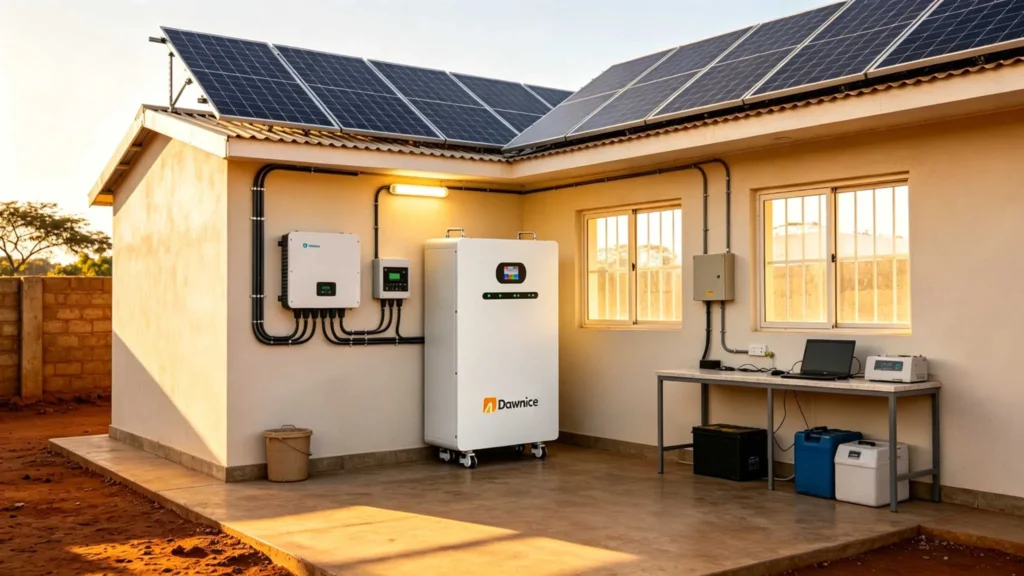
Solar charge controllers need a LiFePO4 profile just like a wall charger does. For a 16S 51.2V pack, configure the MPPT as follows:
- Absorption voltage: 57.6V (3.6V per cell); use 54.4–56V if cycle life matters more than top capacity.
- Float voltage: disabled, or 54V where the controller requires a float value.
- Equalization: off, always.
- Charge current limit: 0.5C of pack capacity or lower.
- Low-temperature cutoff: enabled if the controller or BMS supports temperature sensing.
Setup steps:
- Select the “lithium” or “LiFePO4” preset if the controller offers one — it disables float and equalization by default.
- If no lithium preset exists, switch to the user-defined (custom) profile and enter the absorption voltage for your cell count: 57.6V for 16S.
- Set float to 0 or 54V and confirm equalization is off.
- Set the charge current limit at or below 0.5C of pack capacity.
Lead-acid presets are the trap: they float at 54–55V continuously and include equalization cycles, which LiFePO4 must never receive. For small 12V systems, consumer 12v lifepo4 battery charger units are widely available; for 48V/51.2V commercial installs, installers spec a dedicated 48V/51.2V charger or a lithium-profile MPPT — the same voltage rules apply at any system size.
Charging Safety Checklist for Commercial Installations
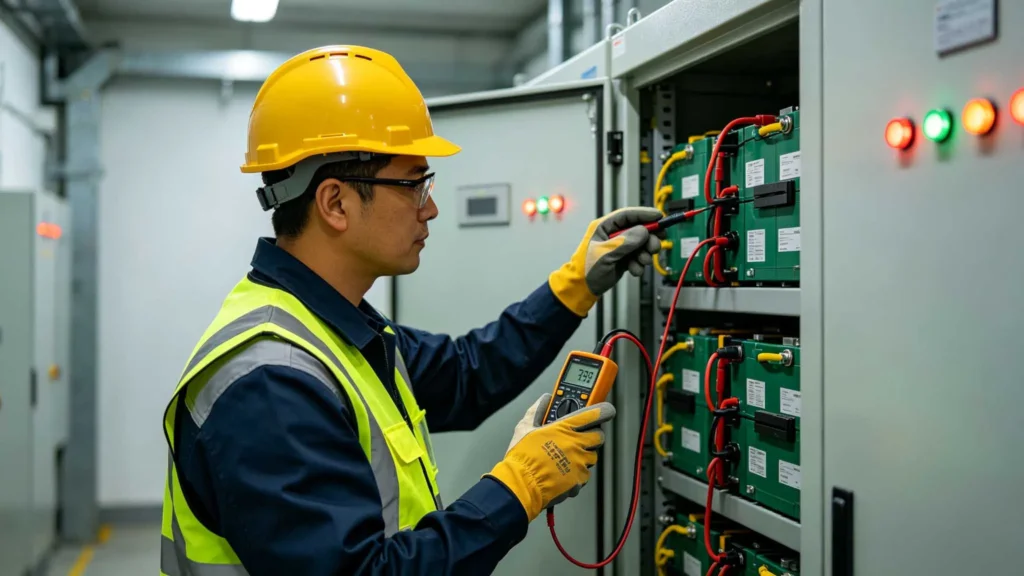
Run this list before energizing any new battery installation:
- Match the charger voltage to the pack cell count: 16S (51.2V) is not 15S (48V).
- Set absorption to 57.6V maximum (3.6V per cell); 54.4–56V for longer cycle life.
- Disable float and equalization on the charger and on the MPPT controller.
- Size charge current at or below 0.5C of pack capacity.
- Verify BMS communication (CAN/RS485) where the charger supports it.
- Use an IP-rated charger appropriate for the site — IP54 or better outdoors.
- Check cable gauge and fuse rating for the charge current.
- Log the first full charge cycle: voltage, current, time, and cell balance.
- Confirm the warranty terms cover the charger–battery combination you install.
- Train site staff on charging limits, BMS alarms, and shutdown procedure.
Final Buying Guide: Charger + Battery from One Supplier
For B2B projects, the cleanest specification is a matched charger and battery from a single supplier. One vendor means one warranty claim path, pre-verified communication settings, documented charging parameters, and a single engineer to call when something trips. Split procurement across vendors converts a simple charging problem into a blame dispute.
Manufacturers such as Dawnice offer 51.2V LiFePO4 packs — 16S, rated 44.8–57.6V, with BMS overcharge, overdischarge, overcurrent, short-circuit and over-temperature protection — and provide the matching charging guidance installers need to spec a charger at the correct 57.6V absorption ceiling. The point is not the brand; it is that the charger profile, pack chemistry, and BMS must be treated as one system from day one.
1. Does a LiFePO4 battery need a special charger?
Yes. LiFePO4 needs a charger with a LiFePO4 profile or adjustable settings. Generic lead-acid chargers add float and equalization, both of which overvolt LiFePO4 cells or hold them at high state of charge — either way, service life drops.
2. What voltage should I charge my 48V LiFePO4 battery to?
It depends on the cell count. For a 16S 51.2V pack, set absorption to 54.4–56V (up to 57.6V) and never exceed 58.4V. For a true 15S 48V pack, absorption is 51.0–52.5V with a 54.75V maximum. Check the nameplate: most modern “48V” packs are 16S.
3. How long does it take to charge a 100Ah LiFePO4 battery?
Use capacity ÷ current × 1.15. At 20A, about 5.75 hours; at 50A, about 2.3 hours. The absorption taper accounts for the extra 15%.
4. Can I charge LiFePO4 with a solar panel directly?
Not directly. You need an MPPT charge controller with a lithium profile: absorption set for your cell count, float and equalization disabled, current limited to 0.5C, and low-temperature cutoff active.
5. Can I use my LiFePO4 battery while it is charging?
Yes — most BMS-equipped systems support pass-through. Keep the combined charge plus discharge current within the BMS continuous rating so protection never trips.