LiFePO4 for Solar Storage: A Commercial & Industrial Buyer’s Guide
LiFePO4 for Solar Storage: A Commercial & Industrial Buyer’s Guide
In commercial and industrial solar storage, the chemistry debate is effectively over. Lithium iron phosphate (LiFePO4) has replaced lead-acid as the default battery technology for new installations, and the market data explains why: LiFePO4 batteries for solar energy storage deliver 4,000–6,000 cycles at 80% depth of discharge, tolerate higher discharge rates, require no maintenance, and carry a far lower fire risk than competing lithium chemistries. For solar installers, EPC contractors and facility managers budgeting for a 10-year system life, the question is no longer whether to specify LiFePO4 — it is which pack to buy. This guide covers the specifications that matter, the voltage and capacity decisions that shape system design, and the total-cost-of-ownership numbers that survive contact with a procurement department. Whether you are replacing an aging lead-acid bank, expanding an existing PV array, or designing a new build from a blank sheet, the same selection logic applies — and that logic is what follows. Every claim below is written for practical selection, not for marketing.
Why LiFePO4 Is the Standard for Solar Storage
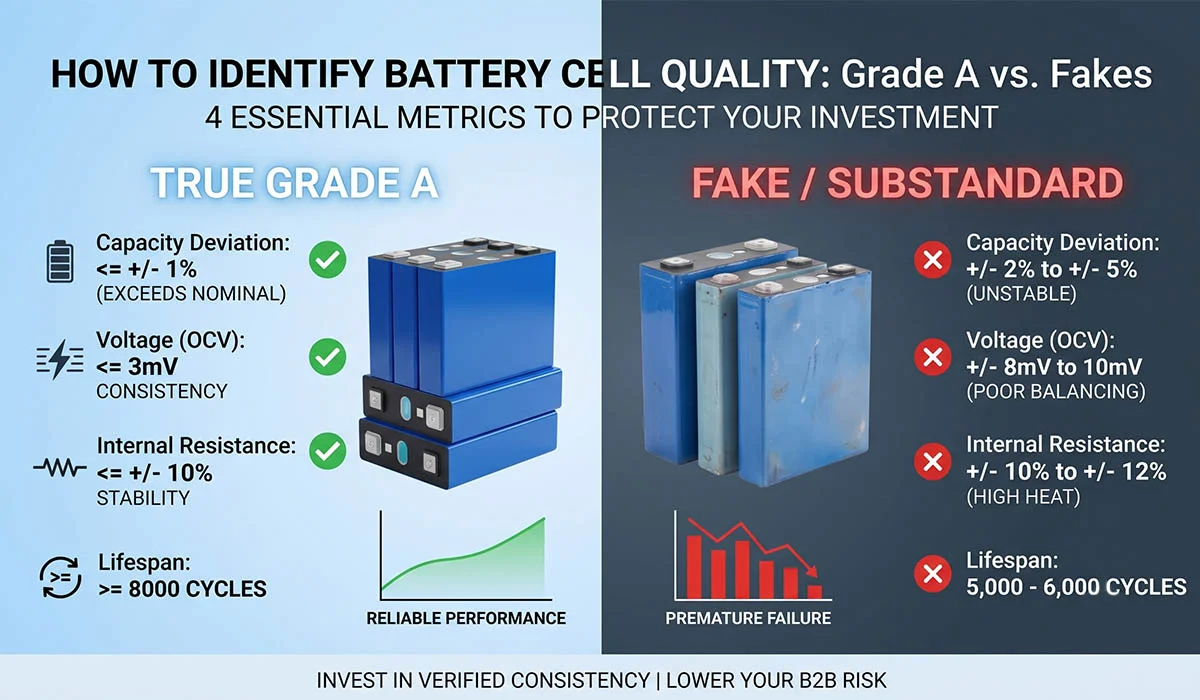
LiFePO4 earned its position through three measurable advantages over the alternatives: cycle life, usable capacity and thermal stability. A quality lithium iron phosphate cell is rated for 4,000–6,000 cycles at 80% depth of discharge (DoD), and top-tier packs quote 8,000 cycles at 90% DoD — 10–15 years of daily cycling. By contrast, a flooded or AGM lead-acid battery delivers roughly 500–1,000 cycles at 50% DoD, meaning two or three replacements inside a typical commercial system lifetime.
The second advantage is usable capacity. A LiFePO4 solar battery can be discharged to 80–90% of rated capacity day after day without damage, so a 10 kWh pack delivers close to 10 kWh. Lead-acid systems cap DoD at 50% to protect the plates, so you need roughly double the bank for the same runtime.
The third is safety. LiFePO4’s olivine cathode is thermally stable and does not release oxygen at elevated temperatures, so thermal runaway — the failure mode that makes NMC lithium problematic in commercial buildings — is extremely rare. Add a zero-maintenance profile (no watering, no equalization) and it is clear why buyers choosing a LiFePO4 battery for solar energy storage rarely look back.
7 Specs to Check Before Buying a LiFePO4 Solar Battery
Before you compare prices, compare these seven numbers. Every one of them changes either the system design or the 10-year cost.
- Nominal voltage (48V vs 51.2V). “48-volt” LiFePO4 packs are actually 51.2V nominal — 16 cells of 3.2V in series. Confirm the pack’s voltage range sits inside your inverter’s battery input window before anything else.
- Capacity in Ah and kWh. Ah × nominal voltage = kWh. A 100Ah, 51.2V pack holds 5.12 kWh; a 200Ah pack holds 10.24 kWh. Buy for the kWh your load actually needs, not the Ah number on the label.
- Depth of discharge (DoD). The spec sheet should state a usable DoD — typically 80–90% for commercial LiFePO4 battery packs. Higher DoD means more usable energy per dollar spent.
- Cycle life at 80% DoD. Cycle ratings are meaningless without a DoD and temperature context. Compare like for like: cycles at 80% DoD and 25°C is the standard baseline.
- BMS features. The battery management system is the pack’s safety brain. Minimum requirements: over-charge, over-discharge, over-current, short-circuit and over-temperature protection, plus cell balancing and a state-of-charge algorithm that stays accurate under load.
- Round-trip efficiency. A LiFePO4 system should hit 95% or better round-trip efficiency. Below that, part of every kWh you store is lost to heat.
- Max continuous charge/discharge current. For commercial loads this determines how fast you can charge from solar and how much power you can draw. A 100Ah pack rated at 100A continuous can deliver about 5.1 kW — enough for a small office, not enough for a welder.
48V vs 51.2V: Which Voltage for Your System?
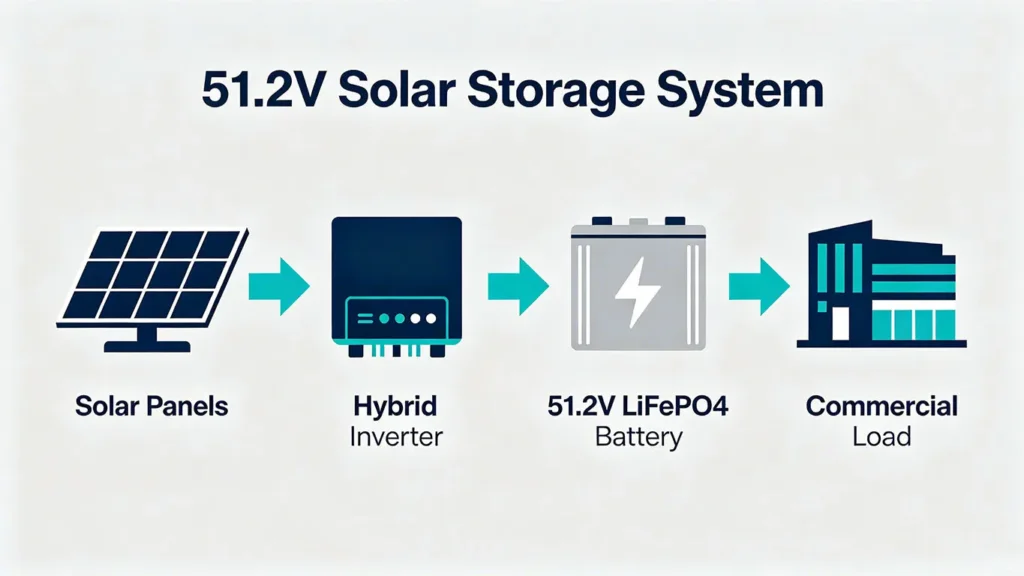
Here is the first thing that confuses every new buyer: the “48V” LiFePO4 battery on most spec sheets is actually a 51.2V system. Sixteen 3.2V cells in series produce 51.2V nominal (operating range roughly 44.8–57.6V), and the industry labels it “48V” because it drops into the same inverter slots designed for older 48V lead-acid banks. When a supplier lists a 51.2V/48V rechargeable solar energy storage LiFePO4 battery, the two numbers describe the same pack — one is the chemistry’s true nominal voltage, the other is the compatibility label. The same platform, sold as a LiFePO4 battery pack for home & solar energy storage at the residential end and as a commercial LiFePO4 battery at the C&I end, is deliberately standardized across the market.
For commercial work, 48V-class (51.2V) systems dominate up to roughly 30 kWh because hybrid inverters in this class are cheap, abundant and interchangeable. Voltage matters in three practical ways:
- Inverter compatibility. Verify the pack’s voltage range (for example 44.8–57.6V) sits inside your inverter’s battery input window. A 51.2V pack pairs with any genuine 48V inverter; a 12V or 24V pack will not.
- Cable gauge. Higher voltage means lower current for the same power, so a 51.2V system needs thinner, cheaper DC cabling than a 24V bank delivering the same kilowatts.
- Parallel expansion. A 51.2V multi-capacity LiFePO4 battery for solar energy storage is designed to scale — the same platform ships as 100Ah, 200Ah, 300Ah and larger packs, and most commercial models support 10–16 units in parallel.
| System voltage | LFP nominal | Typical use | Typical capacity |
|---|---|---|---|
| 12V | 12.8V (4S) | Small off-grid, telecom, RV | 50–200Ah |
| 24V | 25.6V (8S) | Cabins, small backup | 100–300Ah |
| 48V | 51.2V (16S) | Residential + small commercial, most hybrid inverters | 100–500Ah (5–25 kWh) |
| High voltage | 100–900V | Large commercial, industrial, containerized ESS | 30–200+ kWh |
Rule of thumb: under ~30 kWh, stay on 51.2V; above that, go high voltage to control currents and cable costs.
Capacity Sizing: 100Ah, 200Ah or 300Ah for Commercial Loads?
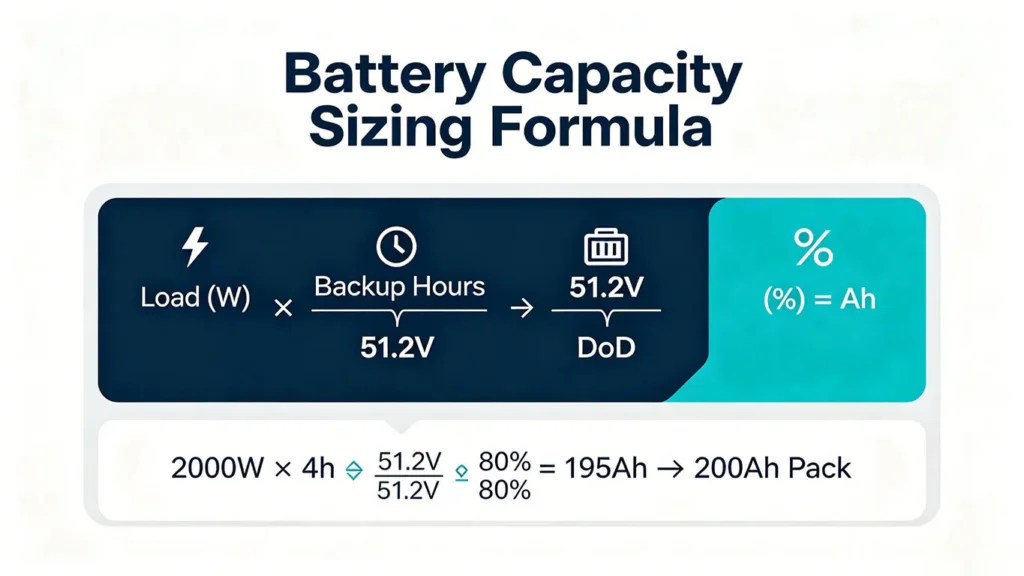
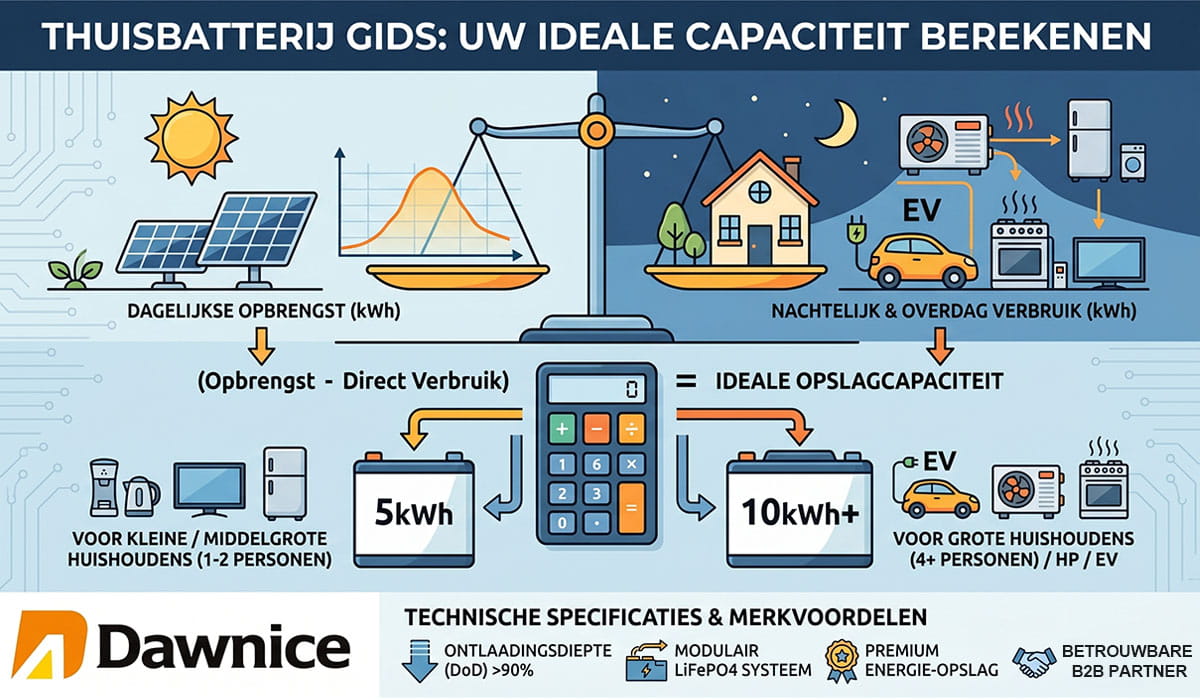
Sizing starts with the load, not the battery. List every load that must run on stored energy, add wattages, multiply by backup hours, then divide by voltage and again by usable DoD. The formula: (load in watts × backup hours) ÷ 51.2V ÷ usable DoD = required Ah.
Worked example: a workshop drawing 2,000W needs 4 hours of backup, or 8,000 Wh. Divided by 51.2V that is 156Ah at 100% DoD; at 80% DoD you need about 195Ah, so size a 200Ah pack. If you are starting from the energy side, convert kWh to watts with the kWh to watts converter, or run your numbers through the battery capacity calculator before you commit to a model.
- 100Ah (5.12 kWh): small office, retail counter, or a few security and network loads overnight. A 48v 100ah lifepo4 pack at 80% DoD delivers about 4.1 kWh of usable energy.
- 200Ah (10.24 kWh): workshop, restaurant, or small factory with essential lighting, refrigeration and power tools. A 48v 200ah lifepo4 pack provides roughly 8.2 kWh usable.
- 300Ah (15.36 kWh): larger commercial loads — a bigger workshop, cold room or multi-zone office needing several hours of whole-premises backup. Usable energy at 80% DoD: about 12.3 kWh.
For anything larger, add packs in parallel rather than buying a single oversized unit. Parallel expansion is cheaper per kWh, provides redundancy — if one pack trips, the others keep the load alive — and lets capacity grow with the business. Just respect the manufacturer’s maximum parallel count (typically 10–16 units for 48V-class packs) and the inverter’s total charge-current limit.
LiFePO4 vs Lead-Acid for Solar: Total Cost of Ownership
Upfront price still favors lead-acid on paper — that is why the lifepo4 vs lead acid for solar comparison keeps coming up. The total cost of ownership over a decade tells a different story, and it is the calculation every procurement team should run before signing.
| Cost factor | Lead-acid (flooded/AGM) | LiFePO4 |
|---|---|---|
| Upfront cost per kWh | Lower (roughly half to one-third of LFP) | Higher |
| Usable depth of discharge | 50% | 80–90% |
| Cycle life | 500–1,000 cycles | 4,000–6,000 cycles (top-tier: 8,000+) |
| Replacements over 10 years | 2–3 banks | 0 (typical) |
| Maintenance | Watering, equalization, terminal cleaning | None |
| Ventilation requirements | Hydrogen ventilation often required | Standard indoor installation |
| 10-year TCO | Higher — multiple banks plus labor | Lower — one purchase |
The arithmetic is blunt. To deliver 5 kWh of usable energy you need a 10 kWh lead-acid bank (50% DoD) but only a 6.25 kWh LiFePO4 bank (80% DoD). The lead-acid bank will also be replaced two or three times in ten years while the LiFePO4 pack is still inside its warranty. Even at double the upfront price per kWh, LiFePO4 wins the decade-long comparison — before counting maintenance labor and swap-out downtime.
Server Rack vs Stackable: Choosing the Right Form Factor
Form factor matters more than aesthetics in a commercial installation, because it decides how the battery fits into the building and how it grows. Two designs dominate the 48V-class market, and the same 51.2V cells ship as a LiFePO4 battery pack for home & solar energy storage in residential towers or as a commercial LiFePO4 battery in rack format — the electrical core is often identical.
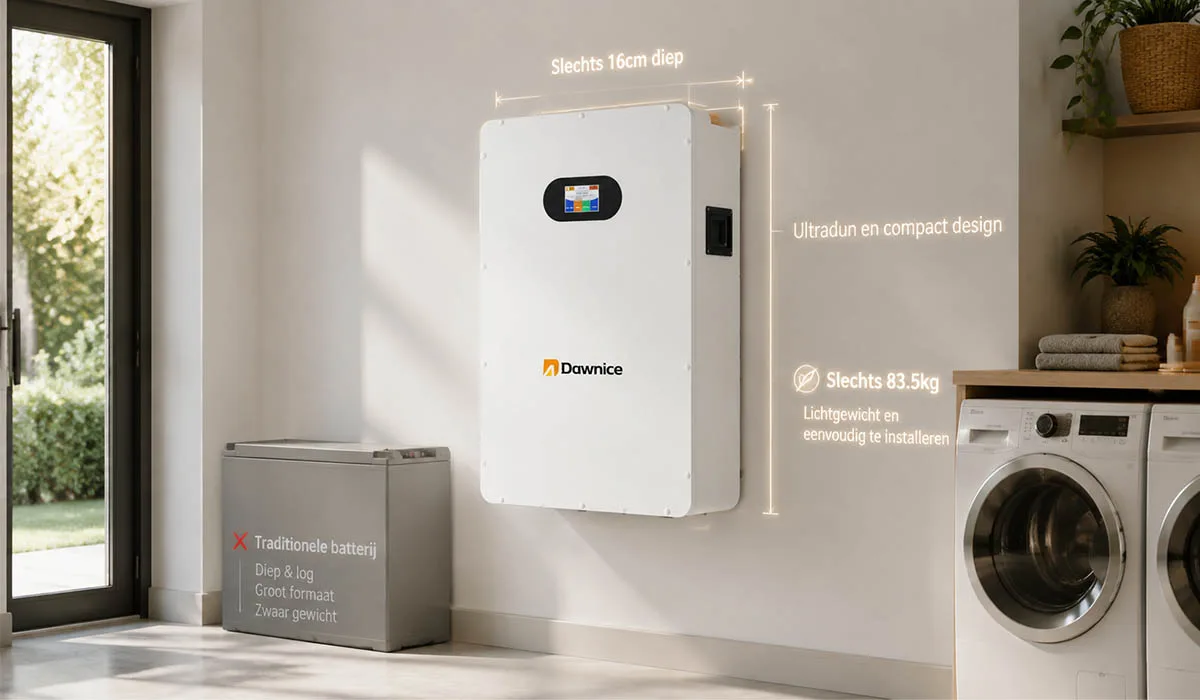
Server rack battery. A 19-inch rack-mount pack (2U–5U) is built for density: multiple modules bolt into a standard rack and share a common busbar, exactly like a data-center UPS. The advantages are the smallest footprint per kWh, clean cable management and fast parallel installation. The trade-off: you need a rack to mount it in.
Stackable. Floor-standing modules stack vertically, each adding 5–15 kWh. No rack required, easy one-module expansion, simpler relocation — but a larger floor footprint per kWh and more exposed cabling.
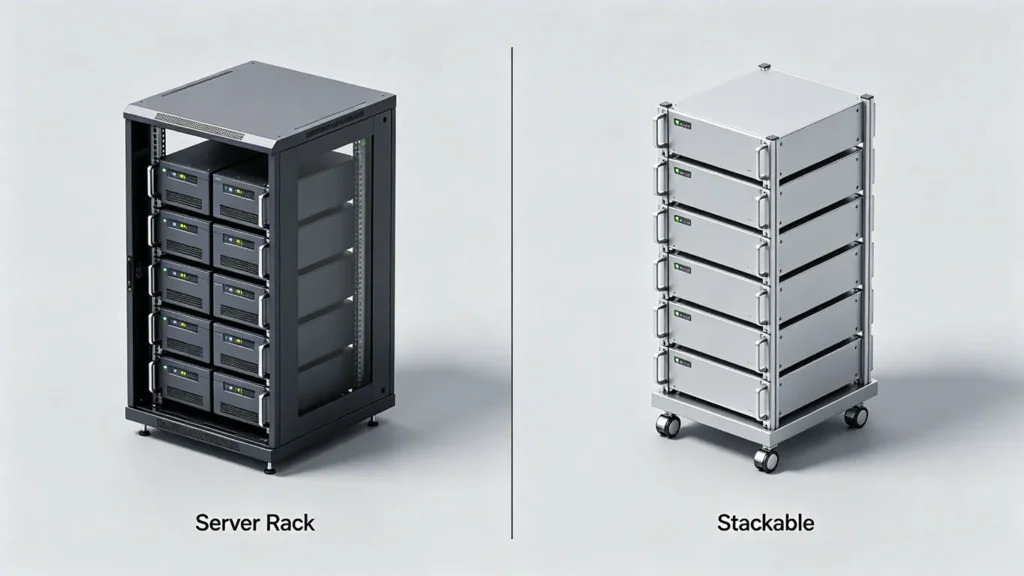
Which to choose: for a commercial or industrial site where floor space is billed by the square meter, specify a server rack battery — density wins. For a remote site, farm or facility with expansion plans and no racking, a stackable tower is the pragmatic choice. Either way, apply the same compatibility checks: voltage range, parallel limit and communication protocol (CAN/RS485) must match the system.
How to Charge LiFePO4 Batteries with Solar
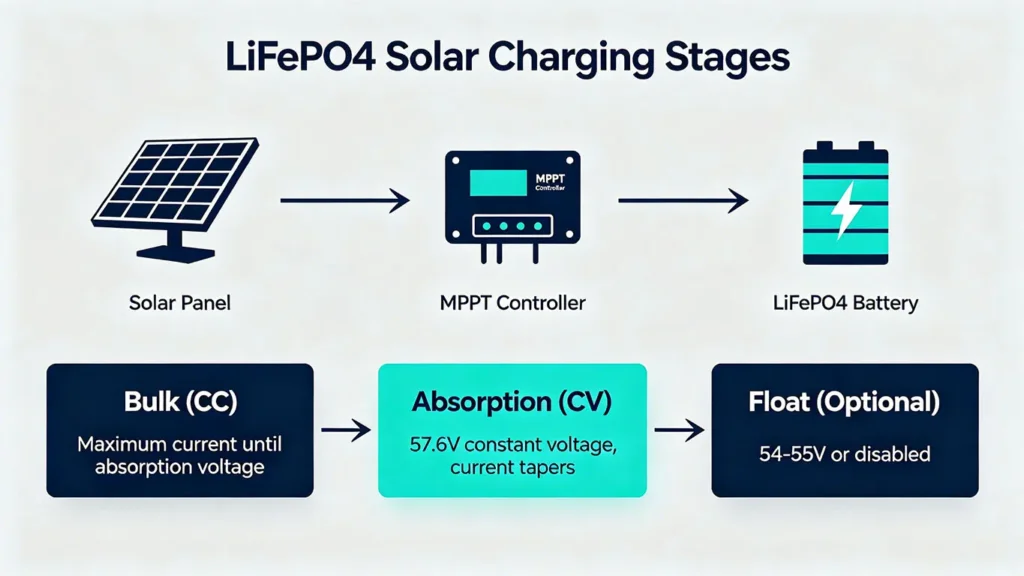
How to charge lifepo4 battery with solar is not complicated, but it requires the right controller settings. Solar panels produce a variable voltage, so a charge controller — preferably MPPT — always sits between the array and the battery, or the inverter’s built-in controller handles the job. The profile has three stages; the third is optional:
- Bulk (constant current). The controller delivers maximum current until the battery reaches the absorption voltage.
- Absorption (constant voltage). For a 51.2V pack, set absorption to about 57.6V (3.6V per cell) and hold it until the current tapers.
- Float (optional). LiFePO4 does not need float charging the way lead-acid does. If the controller insists on a float stage, set it to 54–55V — or disable it and let the battery rest at its natural voltage.
Three settings are specific to LiFePO4: switch off equalization (lead-acid-only; it can damage LFP cells), disable or relax temperature compensation (not needed with LFP’s flat voltage curve), and set the low-voltage cutoff to the pack’s specified range rather than a lead-acid profile.
So can a lifepo4 battery be charged with a solar panel? Yes — directly, through an MPPT controller with a LiFePO4 profile. The controller does all the work; your job is simply to confirm the voltage settings above match the pack’s spec sheet.
BMS, DoD and Cycle Life: What the Spec Sheet Really Means
Spec sheets are marketing documents until you know how to read them. Three numbers are routinely misunderstood, and each one directly affects the commercial decision.

Cycle life is always quoted at a specific DoD. “6,000 cycles” means nothing until the footnote arrives: 6,000 cycles at 80% DoD, 25°C, 0.5C charge/discharge, 70% end-of-life threshold. The same cell at 100% DoD typically delivers roughly half the cycles. In practice: 4,000 cycles at 80% DoD, cycled once daily, is 10+ years of service.
Depth of discharge is a design decision. Running a pack at 90% DoD squeezes more usable energy out of every dollar today but accelerates aging compared with 80% DoD. For commercial duty — daily cycling on revenue-critical loads — 80% is the conservative sweet spot — use it in your capacity calculation.
The BMS is the component you are actually buying. Over-charge, over-discharge, over-current, short-circuit and over-temperature protection should all be present, alongside cell balancing and a state-of-charge algorithm that stays accurate under real loads. For commercial deployments, insist on BMS telemetry you can read — cell voltages, pack temperature and cumulative throughput over CAN/RS485 — so your monitoring platform can track the system and flag drift before it becomes a failure.
Final Selection Checklist for Commercial Buyers
Use this checklist to shortlist any supplier. A pack that passes all nine items is a defensible choice; a pack that fails on the BMS or cycle-life line should be dropped regardless of price.
- Chemistry. LiFePO4 only — no NMC, no “lithium hybrid.”
- Voltage match. Pack voltage range inside the inverter’s input window.
- Capacity. Sized from measured load × hours ÷ voltage ÷ DoD, not from a brochure.
- Cycle life. Quoted at 80% DoD, with temperature and end-of-life context.
- BMS. Five protections, cell balancing and readable telemetry.
- Round-trip efficiency. 95% or better.
- Certification. IEC 62619, UL 1973 or equivalent pack-safety standard; UN38.3 for transport.
- Parallel support. Documented maximum parallel count and communication protocol (CAN/RS485).
- Warranty and service. A 10-year warranty with real local support. Example: Dawnice, a China-based ESS manufacturer, offers 5+5-year warranties on residential and commercial packs — use their spec sheets as a benchmark, but verify whichever supplier you choose.
The best lifepo4 battery for solar system is the one that matches your load profile, budget and service reality. Match the battery to your load profile, not the marketing brochure.
Frequently Asked Questions
Can a LiFePO4 battery be charged with a solar panel?
Yes. Connect the panel through a charge controller (MPPT preferred) configured with a LiFePO4 profile — absorption around 57.6V for a 51.2V pack, float disabled or set to 54–55V, equalization off. The controller manages current and voltage — the battery does not care where the energy comes from.
How long do LiFePO4 solar batteries last?
In cycle terms, 4,000–6,000 cycles at 80% DoD is standard for quality cells, with top-tier packs rated to 8,000 cycles at 90% DoD. Cycled once daily, that is 10–15 years — and most commercial packs carry a 10-year warranty. Calendar aging matters too: keep the pack within its rated temperature range.
What is the best voltage for a commercial solar battery?
For systems up to roughly 30 kWh, 51.2V (48V-class) is the practical choice — abundant inverters, safe DC voltages, easy parallel expansion. Above that, move to high voltage (150–900V) to control currents and cable costs.
Is LiFePO4 safer than lead-acid for indoor commercial use?
Yes. LiFePO4 does not emit hydrogen while charging, has no acid to spill, and its cathode is thermally stable, so thermal runaway is extremely rare. Lead-acid banks require ventilation for hydrogen and acid containment. Still, follow the manufacturer’s installation requirements.
How many LiFePO4 batteries can I connect in parallel?
It depends on the pack design and BMS, but typical 48V-class commercial packs support 10–16 units in parallel — some models allow up to 15. Respect the manufacturer’s stated maximum, and confirm the total stays within the inverter’s charge/discharge current limit and the DC busbar rating.